Is It Bad That My Kid Would Rather Watch an iPad Than Play With Me?
Short answer: not necessarily. Choosing an iPad over play in the moment does not mean your child prefers the device to you. Some digital media is engineered to hold attention very effectively, while your responsive, back-and-forth attention gives a child social and developmental experiences a passive screen cannot replace.
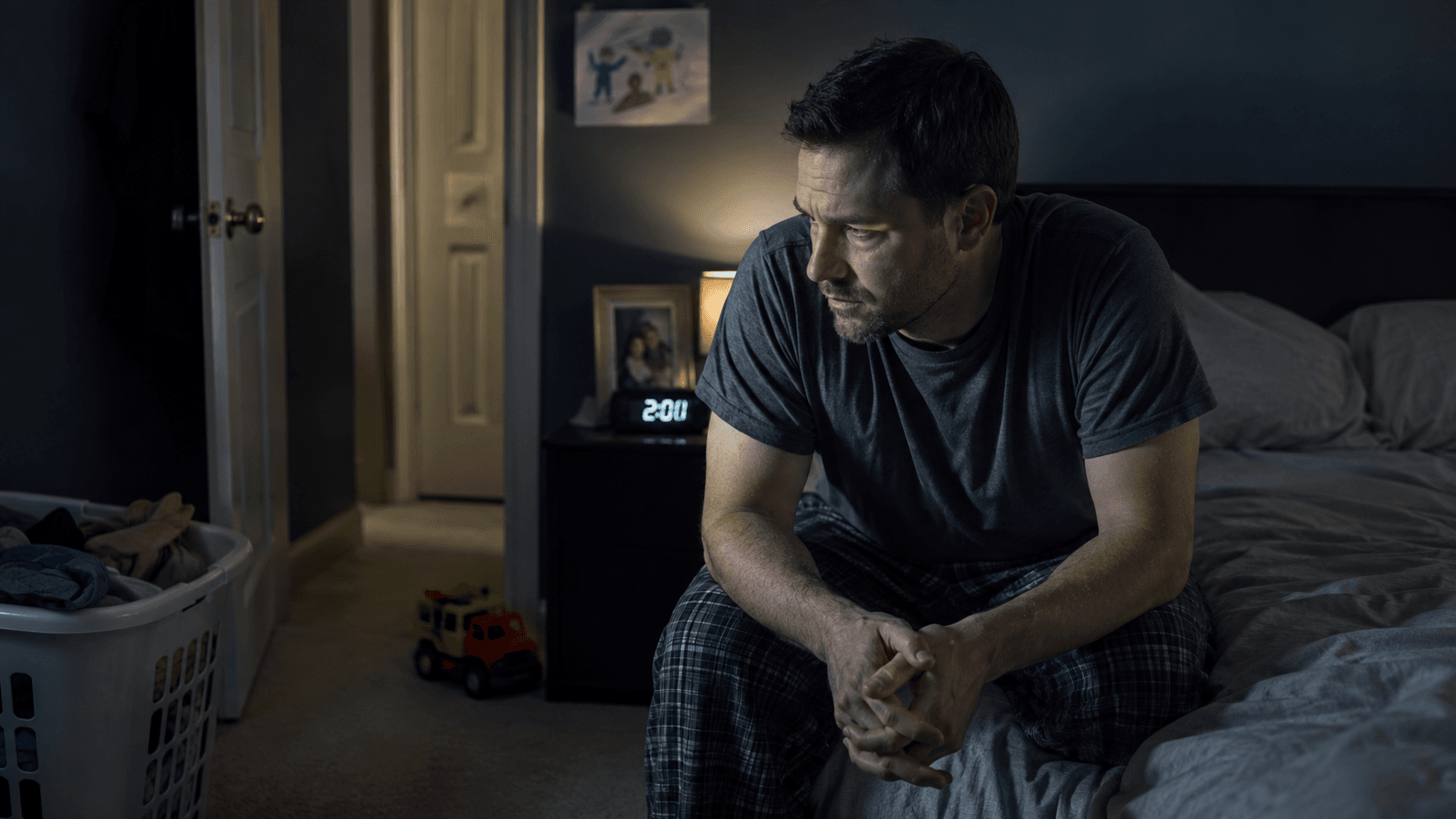
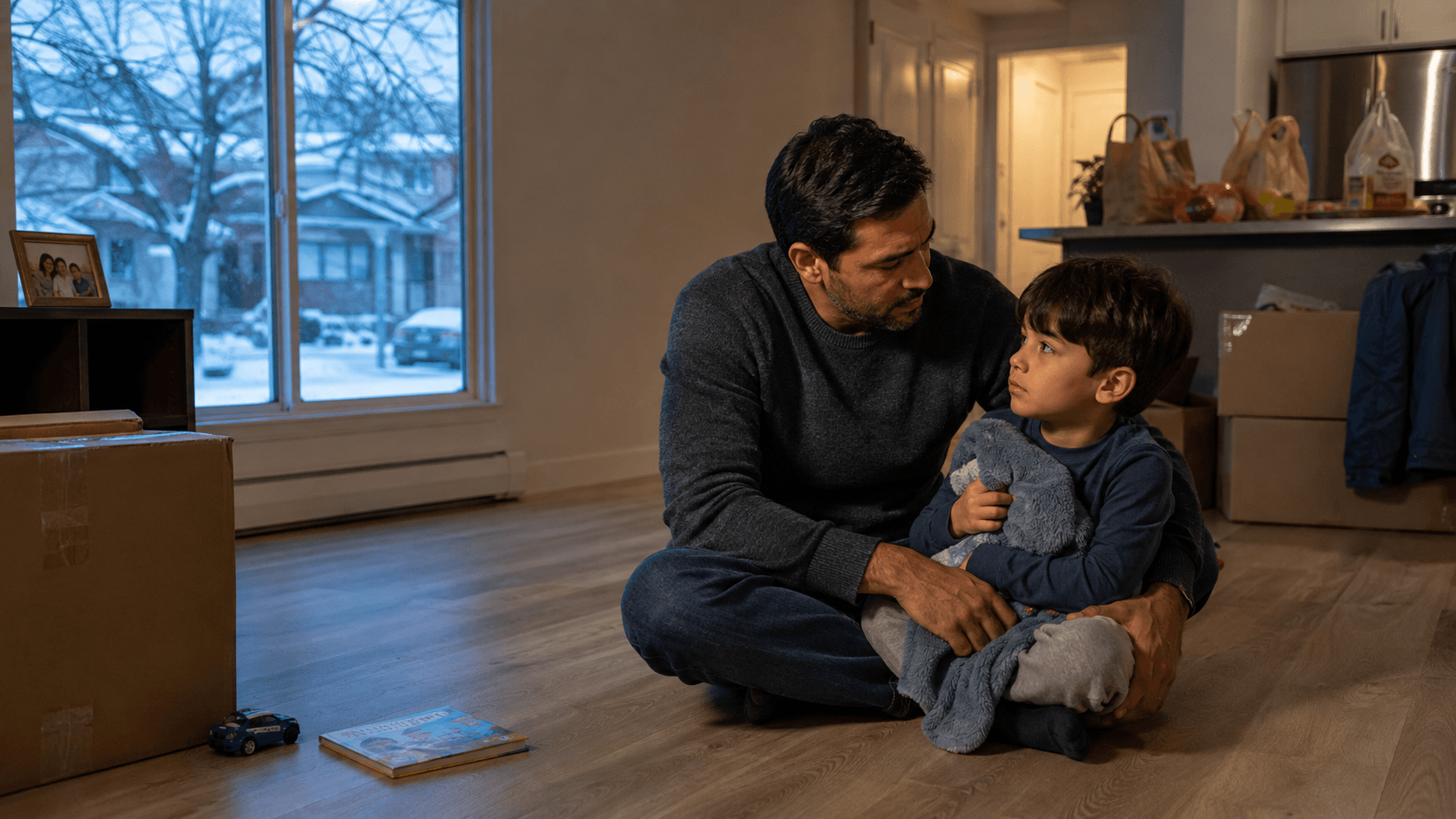
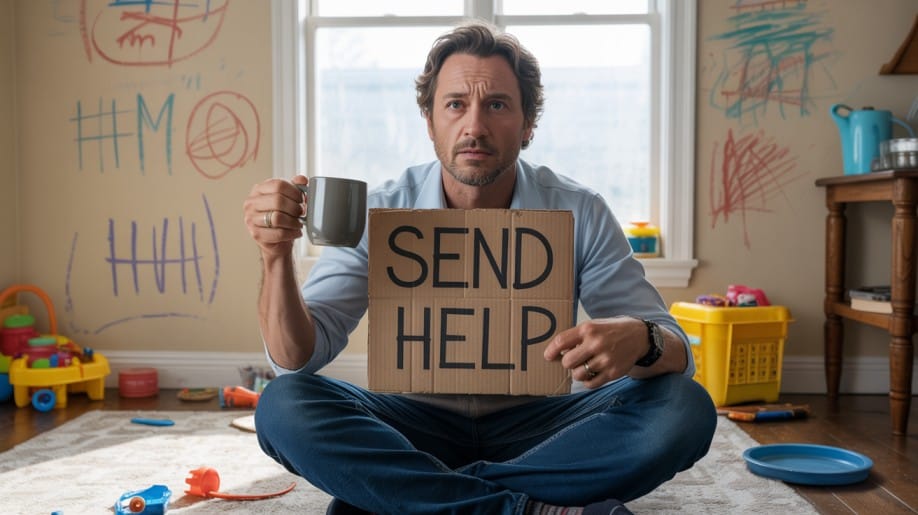
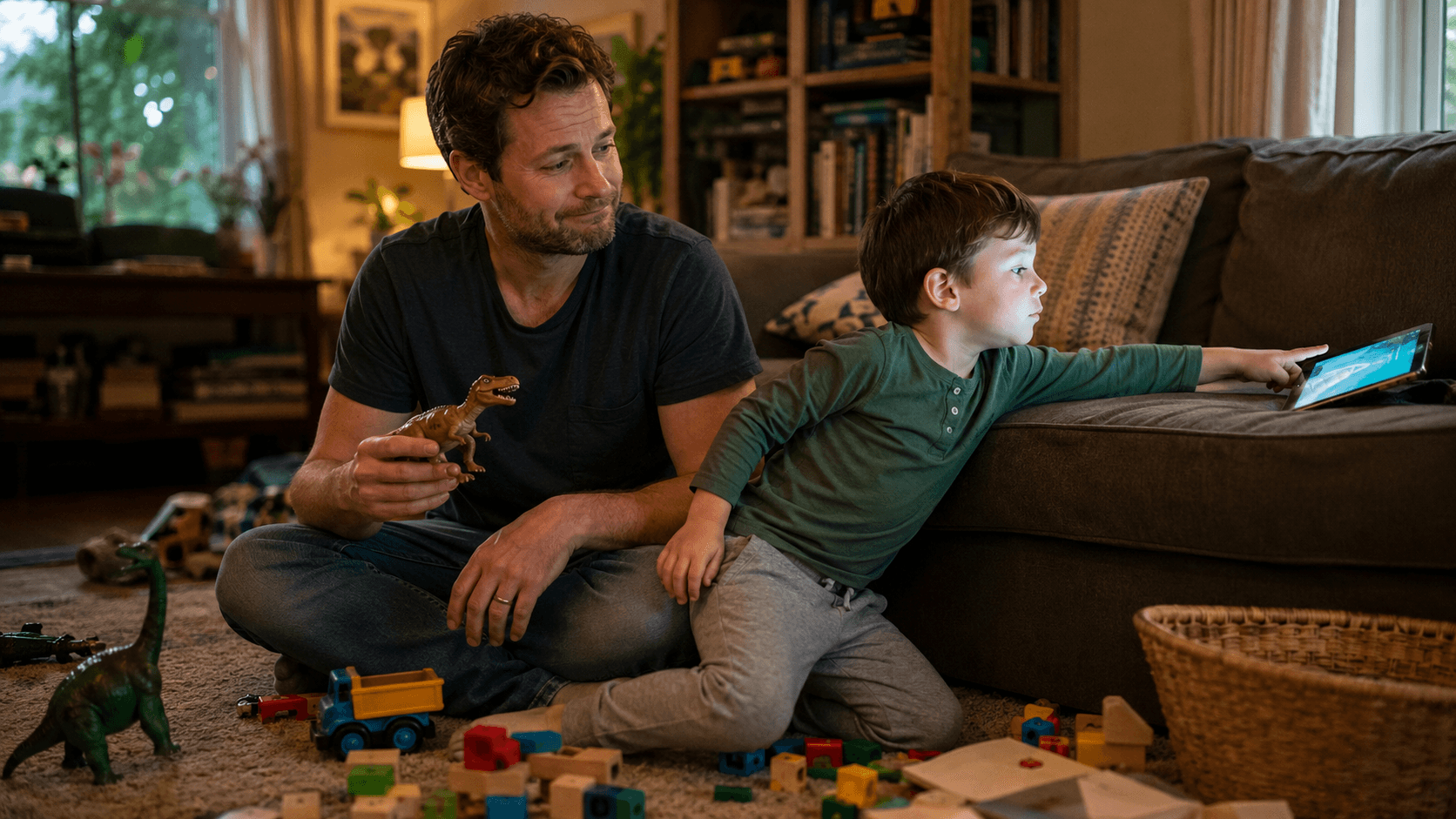
I was on the living room floor, doing the voices. Both of them. The little dinosaur one and the slightly panicked truck. I had committed. And somewhere around the third minute my son reached past my shoulder for the tablet on the couch, the way you reach past a stranger for the last seat on the train.
He didn’t even look at me while he did it.
There’s a specific thought that lands in that moment, and it lands hard. He’d rather have the screen than me. I’m his father, I’m right here on the floor making a fool of myself, and I’m losing to a rectangle.
So here’s the question I stayed up researching after everyone finally went to sleep, which is the only time I do anything: is it bad that my kid would rather watch an iPad than play with me?
The short version of what I found: no. It isn’t bad, and it isn’t about you. Choosing the iPad in that moment is not the same as choosing the iPad over you. Some screens are simply built to be hard to look away from, on purpose, by people who are very good at their jobs.
Let me show you the machine you’re up against, whether it’s actually hurting him, the one thing the tablet can’t do, and what I changed once I understood all of it.
Key Takeaways
- If your kid picks the iPad over you, that is not a verdict on you as a parent. Some apps are engineered to hold attention very effectively, which is different from your child preferring the screen to you.
- Given the choice, children “will nearly always opt for talking, playing, or being read to over screen time,” which is the opposite of rejection (Canadian Paediatric Society).
- Unpredictable rewards make a behaviour unusually hard to stop (National Research Council); separately, features like autoplay and endless scroll can stretch how long kids stay engaged (American Academy of Pediatrics).
- Heavy screen use is linked to poorer sleep and less play, but most of these findings are associations, not proof that screens cause harm (Canadian Paediatric Society).
- What passive screen time cannot replace is responsive back-and-forth, the “serve and return” that helps build a child’s brain (Harvard Center on the Developing Child).
- Start tonight: make one screen-free zone, sit and watch with him instead of handing off, and stop reaching for the tablet as the default way to calm him down.
The Short Answer: It’s Not You, It’s the Design
No, it is not bad that your child reached for the iPad, and it does not mean you have failed. Choosing the screen in the moment is not the same as choosing it over you. The Canadian Paediatric Society actually makes this point directly: “given the choice, children will nearly always opt for talking, playing, or being read to over screen time in any form” (Canadian Paediatric Society, Screen time and preschool children, 2022). What a well-made app is genuinely good at is holding attention in the moment, which is a narrower thing than winning your child’s heart.
I want to be honest about how much better I felt once I stopped reading it as rejection. A small child reaching for the brightest, fastest thing in the room says nothing about how much he loves you. In the moment, a device that responds every few seconds is simply easier to grab than a slow-building game of blocks. That pull is real, and on a tired night I feel it too.
The word I had been using was “bad.” As in, am I a bad dad, is this bad for him, is something bad happening. The more useful word turned out to be “rigged.” Once you see how the machine is built, the guilt loosens its grip and you can actually do something about it.
What Is the Tablet Actually Doing That I’m Not?
Some high-engagement apps can hand out little rewards every few seconds, sometimes on a schedule your child can’t predict, and they never get tired or have to get up to check on dinner. On pure moment-to-moment stimulation, you are not going to match them. The good news, which I’ll get to, is that you were never supposed to.
To understand why you lose that particular contest, it helps to look at three things happening under the glass.
Dopamine Isn’t Pleasure, It’s a “Do That Again” Signal
A lot of what keeps pulling your kid back to the screen isn’t really about fun. It works more like a quiet nudge to do the thing again.
Most of us picture dopamine as the brain’s little burst of pleasure. It isn’t, quite. The National Institute on Drug Abuse explains that scientists now think dopamine “has more to do with getting us to repeat pleasurable activities (reinforcement) than with producing pleasure directly.” When the reward circuit lights up, that burst of dopamine “signals that something important is happening that needs to be remembered.” And here is the part that matters for a parent on the floor with the blocks: that same signal “causes changes in neural connectivity that make it easier to repeat the activity again and again without thinking about it, leading to the formation of habits” (National Institute on Drug Abuse, Drugs, Brains, and Behaviour: The Science of Addiction).
One caution here, because it matters and it is easy to overstate. Dopamine’s role in reinforcement and habit formation is well established, but that does not mean ordinary tablet use works like a drug addiction, and the research above does not claim it does. The honest, narrower point is the useful one: a screen can become a habit the brain is primed to repeat, and that can help explain some of the pull you see on the couch.
Why Unpredictable Rewards Are So Hard to Put Down
Part of what makes some apps hard to put down isn’t that their rewards are big. It’s that they arrive unpredictably, and unpredictable rewards are among the stickiest patterns in behavioural science.
This is old, well-established behavioural science. A review prepared for the National Research Council lays it out plainly: after a behaviour has been learned on a variable, unpredictable reward schedule, getting rid of it “is more difficult than with any other type of reinforcement schedule,” and “the sequence of outcomes in some forms of gambling (e.g., slot machines) is quite similar to a partial reinforcement schedule” (National Research Council, Pathological Gambling: A Critical Review, 1999). That research is about behavioural science and gambling, not about your child’s specific app, and it helps to be precise about the mechanisms. Some apps use genuinely unpredictable rewards. Others rely on different engagement features, such as autoplay, endless scroll, and recommendation algorithms. The mechanisms are not the same, but the American Academy of Pediatrics notes that features like these can keep a child engaged longer (American Academy of Pediatrics, Kids & Screen Time: How to Use the 5 C’s of Media Guidance, 2026).
Now think about what you offer during a game of blocks. Your rewards are steady and predictable. The tower goes up, the tower falls down, you both laugh, repeat. Some children’s media leans the other way, with the next little surprise always almost here, and that unpredictability is good at holding attention. That is a design choice, not your failing.
The Apps Are Designed to Keep Him Watching
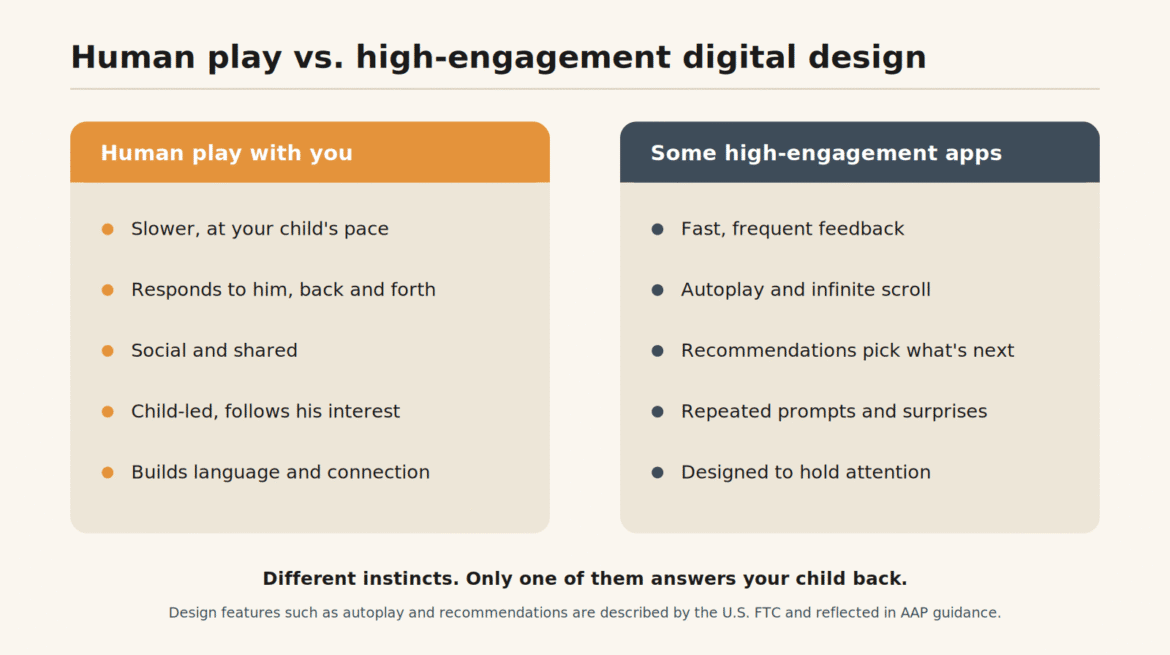
This part isn’t an accident, and it definitely isn’t your kid being weak. The features that keep him watching were built to keep him watching.
This is exactly why the American Academy of Pediatrics, in its 2026 guidance, moved away from counting hours alone and toward looking at what a child is using and how it is designed to behave. Simple time limits, the AAP notes, “don’t address all of the things children and teens need to have a healthy relationship with media.” The design and the context now matter as much as the clock (American Academy of Pediatrics, Kids & Screen Time: How to Use the 5 C’s of Media Guidance, 2026).
The U.S. Surgeon General’s advisory, focused mainly on older children and social media, names the tools directly. “Push notifications, autoplay, infinite scroll, quantifying and displaying popularity (i.e., ‘likes’), and algorithms that leverage user data to serve content recommendations are some examples of these features that maximize engagement.” The same advisory notes that these platforms are “often designed to maximize user engagement, which has the potential to encourage excessive use and behavioral dysregulation” (Office of the U.S. Surgeon General, Social Media and Youth Mental Health, 2023).
The Federal Trade Commission goes further and calls some of this what it is: dark patterns, meaning “design practices that trick or manipulate users into making choices they would not otherwise have made.” Autoplay makes their list. So does a tactic aimed squarely at kids: “using characters that children know and trust to pressure them into making a certain choice.” The FTC even describes the exact thing that happens on the couch, where after one video ends, “a less kid-friendly video, or a sponsored ad camouflaged to look like a recommended video, automatically plays” (Federal Trade Commission, Bringing Dark Patterns to Light, 2022). Britain’s privacy regulator has a whole standard on “nudge techniques,” the “design features which lead or encourage users to follow the designer’s preferred paths,” and it exists specifically because children are more easily led by them (UK Information Commissioner’s Office, Age Appropriate Design Code, 2020).
So when you feel like you’re competing with a toy, you’re not. You’re competing with a design team. And losing that contest, minute to minute, is not a personal failing. It’s a design you didn’t build.
Okay, but Is It Actually Bad for Him?
Probably not the catastrophe the internet implies. But heavy use is consistently linked to worse sleep and less play, and those links are real even if the headline “screens cause X” mostly isn’t proven yet.
I want to be careful here, because the panic industry around this stuff is enormous and I don’t want to add to it. Kids who use a lot of screens do tend to have poorer outcomes in some areas, but heavy screen time also means less of the good stuff, less talking and playing and sleeping, so untangling what actually caused what is genuinely hard. The researchers say so themselves.
The strongest, most consistent signal is sleep. The Canadian Paediatric Society notes that “associations between screen time before bedtime and sleep problems have been more consistent in this age group,” and recommends avoiding screens for at least an hour before bed “given the potential for stimulating and melatonin-suppressing effects” (Canadian Paediatric Society, Screen time and preschool children, 2022). Language is next: the same body points to a meta-analysis that “clearly associated greater quantity of screen use and exposure (including background TV) during infancy with lower language skills at 3 to 4 years of age.”
Then there’s the thing I did constantly and felt worst about: handing over the tablet to stop a meltdown. A longitudinal study in JAMA Pediatrics found that, in children aged three to five, more frequent use of mobile devices for calming was associated with higher emotional reactivity over time, and the two appeared to feed each other back and forth. It was an association, not proof of cause, and it was clearest in boys and in more temperamental kids. The lead researcher put it gently: a device “may seem like a harmless, temporary tool,” but “there may be long-term consequences if it’s a regular go-to soothing strategy” (Radesky JS et al., JAMA Pediatrics, 2022; plain-language summary from (University of Michigan Health)). Not a catastrophe. A habit worth watching.
The U.S. National Institutes of Health is running a major longitudinal study, the ABCD Study, following nearly 12,000 kids into early adulthood. Even they are cautious, and one of their own researchers admits “there’s almost no correlation between what parents report about kids’ screen use and what the kids report” (NIH MedlinePlus Magazine, on the ABCD Study, 2019). If the people with the MRI machines are hedging, so should the rest of us. Here’s how I’d sort what we actually know from what we don’t.
| The finding | What the research shows | How consistent is the evidence? | Source |
|---|---|---|---|
| Screens near bedtime and worse sleep | The most consistent signal in this age group | Consistent across studies | CPS, 2022 |
| Heavy screen time crowds out play, talk, and activity | Screen time replaces other activities | Well established | WHO / CPS |
| More early screen time and lower language at ages 3 to 4 | Linked to lower language scores later | Consistent association | CPS, 2022 |
| Device as the routine soother and higher emotional reactivity | Each appears to feed the other over time | Longitudinal association | Radesky, JAMA Peds, 2022 |
| Screen time harms attention | Studies disagree | Mixed findings | CPS, 2022 |
| Long-term effects on the developing brain | Large study still in progress | Still uncertain | ABCD Study / NIDA |
The consistency labels are my plain-language summary of the sources above, not a formal evidence grade.
So the honest risks cluster around sleep and around everything the screen quietly displaces. Which points straight at the thing screens can’t replace.
The One Game a Passive Screen Can’t Play
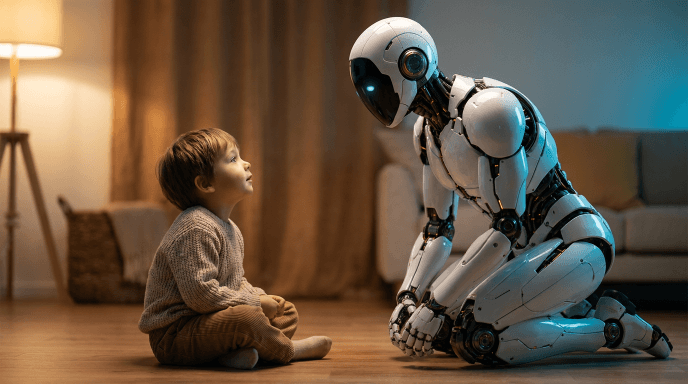
Here’s the part that reframed it for me. Passive screen time, the kind that just plays at a child, can’t provide one of the most important things a young brain needs: a real person responding to him in real time.
The Harvard Center on the Developing Child calls it “serve and return.” A child babbles, points, cries, or holds something up. The adult responds with eye contact, words, a hug. Do that thousands of times and you are physically building a brain. In their words, these “responsive, back-and-forth exchanges between a young child and a caring adult play a key role in shaping brain architecture,” and when a child gestures or babbles and an adult responds, “this back-and-forth interaction, known as serve and return, helps to build and strengthen neural connections in the child’s brain” (Harvard Center on the Developing Child, Serve and Return). A passive screen playing at him doesn’t return the serve. A video call with grandma, or a show you watch together and talk about, can carry some of that back-and-forth, which is exactly why pediatricians treat those differently. A device left to autoplay on its own cannot. It doesn’t know he’s there.
This is why researchers talk about a “video deficit,” the finding that young children, especially infants and toddlers, generally learn less effectively from video than from live interaction. The American Academy of Pediatrics puts it in a way I keep thinking about: “A toddler learns a lot more from banging pans on the floor while you cook dinner than he does from watching a screen for the same amount of time, because every now and then the two of you look at each other.” They add that it takes “around 18 months for a baby’s brain to develop to the point where the symbols on a screen come to represent their equivalents in the real world,” and, remarkably, that a parent normally speaks about 940 words an hour around a toddler, a number that falls by 770 words when the television is on (American Academy of Pediatrics, HealthyChildren.org, Why to Avoid TV for Infants and Toddlers).
And play itself, the thing you were doing on the floor, is not filler. The Academy’s clinical report on play calls it “a singular opportunity” for the social, emotional, language, and self-regulation skills that build executive function, and notes that the shared joy of playing together “regulate[s] the body’s stress response” (American Academy of Pediatrics, The Power of Play, 2018). The same author, writing for parents, says it about as directly as it can be said: “it is parents and caregivers’ presence and attention that enriches children, not fancy electronic gadgets” (American Academy of Pediatrics, The Power of Play: How Fun and Games Help Children Thrive, 2023).
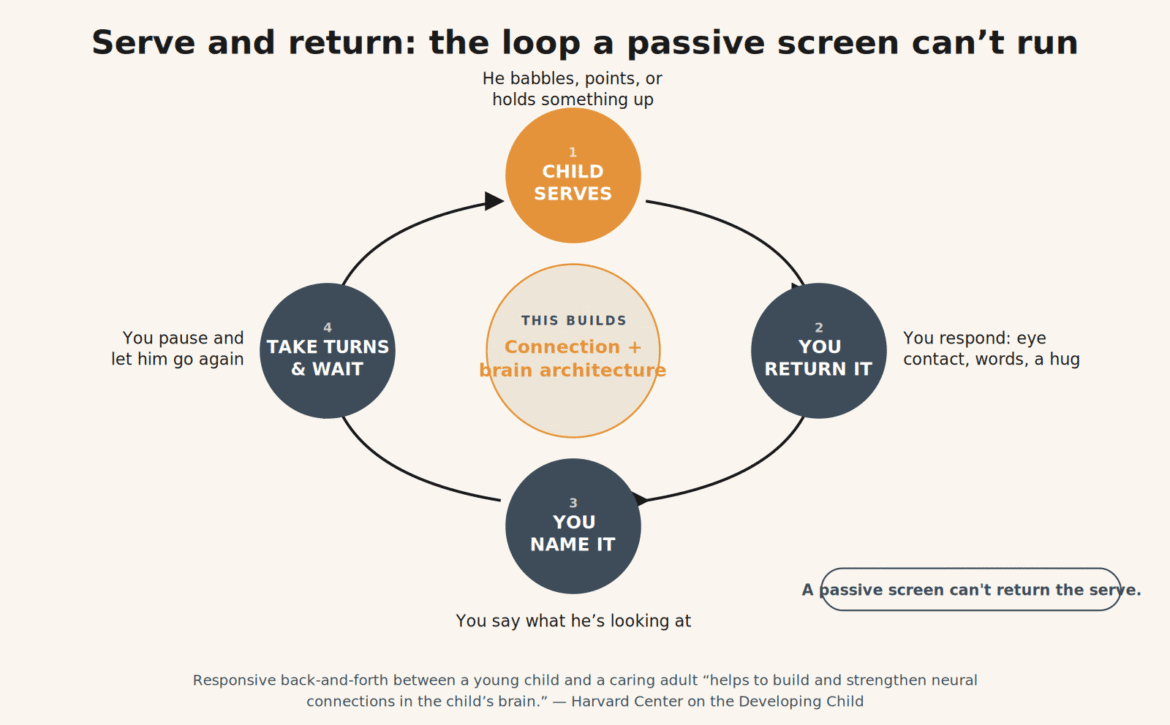
So here’s the reframe I needed. You may lose the contest for moment-to-moment attention, and that is fine. A screen can out-stimulate you right now and still be unable to do the one thing that actually builds him. The goal was never to be more exciting than the iPad. The goal is to keep doing the quiet thing the iPad can’t.
How Much Screen Time Is Actually Recommended?
For kids under two, the official guidance is essentially none beyond video calls. For ages two to five, it’s about an hour a day or less. For older children, the guidance increasingly looks at more than time alone, though Canada still gives a number: ages 5 to 17 should aim for no more than two hours of recreational screen time a day.
I’m Toronto-based, so I lead with the Canadian guidance, but the major bodies land in nearly the same place. Here’s the clean version.
| Age | What’s recommended | Source |
|---|---|---|
| Under 1 | No screen time | WHO, 2019 |
| Under 2 | None apart from video-chatting with family | Canadian Paediatric Society, 2022 |
| 2 to 5 | About 1 hour a day or less of quality content | Canadian Paediatric Society, 2022; AAP |
| 2 to 4 | No more than 1 hour, less is better | WHO, 2019; Canadian 24-Hour Movement Guidelines |
| 5 to 17 | No more than 2 hours a day of recreational screen time | Canadian 24-Hour Movement Guidelines |
| Any age | Weigh content, design, and context, not just hours | American Academy of Pediatrics, 2026 |
A couple of things worth saying out loud. For school-aged kids, the Canadian Paediatric Society leans less on a strict hourly cap and more on a plan built on four habits it calls Manage, Meaningful, Model, and Monitor (Canadian Paediatric Society, Digital media, 2019). The World Health Organization frames its numbers around a simple swap, “making the shift from sedentary time to playtime, while protecting sleep” (World Health Organization, To grow up healthy, children need to sit less and play more, 2019). And the U.S. Centers for Disease Control keeps it concrete for preschoolers: no more than an hour a day of quality programming, and “keep television sets out of your child’s bedroom” (CDC, Positive Parenting Tips: Preschoolers).
If your household is over these numbers, welcome, so was mine. Treat them as a direction to head, not a grade on how you’re doing.
What to Change Tonight (No Philosophy, Just Moves)
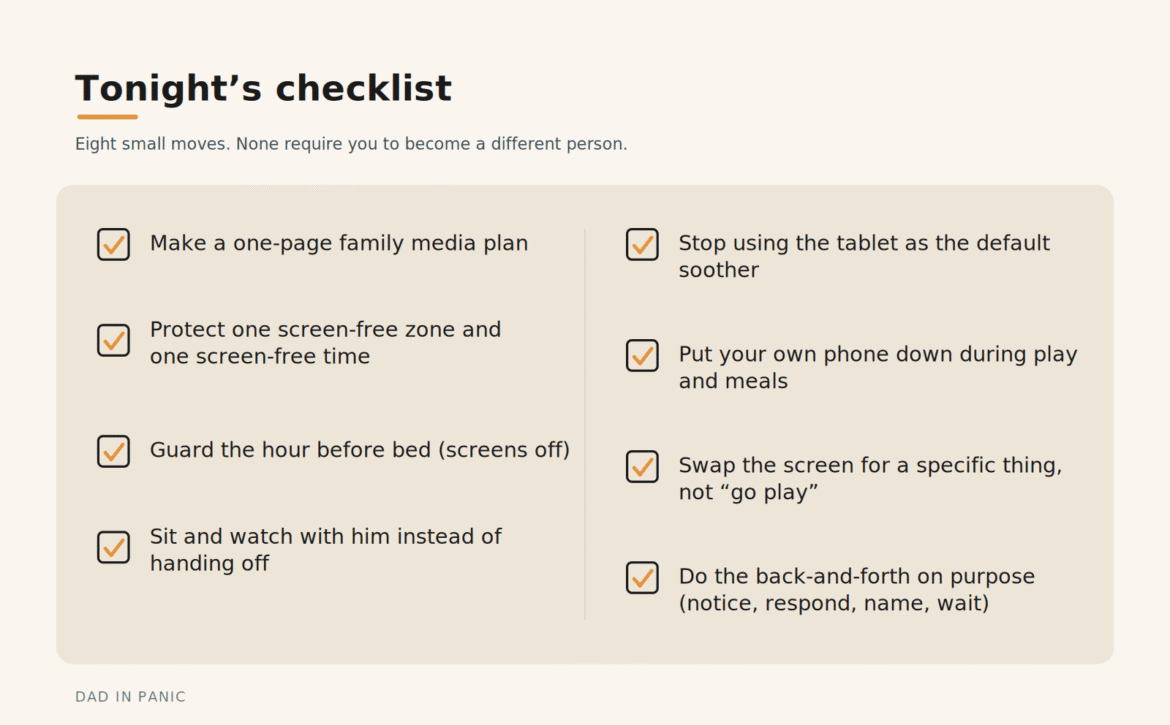
You don’t need to declare war on the iPad. You need a few small structural changes so the tablet stops being the path of least resistance. Every item below traces to an official recommendation, and none of them require you to become a different person.
- Make a one-page family media plan. Decide when and where screens happen, before the meltdown rather than during it. Both the American Academy of Pediatrics and the Canadian Paediatric Society recommend a written plan with time and content limits (AAP, Helping Kids Thrive in a Digital World; CPS, Digital media, 2019).
- Protect one screen-free zone and one screen-free time. Start with bedrooms and mealtimes, the two the pediatric bodies name first (AAP, Helping Kids Thrive in a Digital World).
- Guard the hour before bed. Screens off at least an hour before sleep, which is the most consistent finding in the whole field (CPS, Screen time and preschool children, 2022).
- Sit and watch with him. Co-viewing beats handing off. The AAP’s advice is blunt: “Watch and play alongside your kids. This is the best way to know what they’re consuming and how they’re responding” (AAP, Helping Kids Thrive in a Digital World).
- Stop making the tablet the default soother. Kids need other ways to calm down, and the device shouldn’t be the only tool in the box (AAP, the 5 C’s of Media Guidance).
- Model it yourself. Put your own phone down during play and meals. The CPS specifically asks parents to “minimize their own screen use around young children, especially during mealtimes, play” (CPS, Screen time and preschool children, 2022). This one stung, and it’s the one that changed the most in my house.
- Swap the screen for a specific thing, not “go play.” Name it: read this book, build this fort, kick this ball outside. The CPS suggests “shared reading, outdoor play, easy board games, and crafts” (CPS, Screen time and preschool children, 2022), and the WHO points to reading, storytelling, and puzzles with a caregiver (WHO, To grow up healthy, children need to sit less and play more, 2019).
- Do the back-and-forth on purpose. Harvard’s five steps are almost embarrassingly simple: notice what he’s focused on, respond to it, name it out loud, take turns and wait for him, then follow his lead when he’s done (Harvard Center on the Developing Child, 5 Steps for Brain-Building Serve and Return).
None of this makes you more exciting than the iPad. It just makes sure the tablet isn’t the only thing in the room that ever answers him back.
He still reaches for the screen sometimes. He reached for it yesterday. But last night he reached for me first, held up a wobbly tower, and waited to see my face. I returned the serve. That’s the whole game, and it’s the one the iPad can’t play.
About the Author
Vitor Medrado is a Toronto-based writer and creative leader with more than twenty years in advertising, including senior creative roles at Ogilvy, DDB, and Publicis and recognition at Cannes Lions, the Effies, and D&AD. Today he works in creative strategy and AI integration, and he writes Dad in Panic from lived experience as a father, not as a clinician or parenting expert. Read his full bio on the Dad in Panic About page.
Selected work and press: Ads Spot · Ads of the World · LatinSpots · Adobo Magazine · Adlatina · Publicis Brasil · Update or Die · Janela · Acontecendo Aqui · VoxNews · Blog do Adonis.
How this was made: Vitor wrote, directed, edited, and fact-checked this article against the official sources listed below, with AI assistance used for research and drafting.
Last reviewed: August 2026. Screen-time guidance changes, so this page is checked against current official sources.
Sources
- National Institute on Drug Abuse (NIDA), National Institutes of Health. Drugs, Brains, and Behavior: The Science of Addiction, Drugs and the Brain.
- National Research Council. Pathological Gambling: A Critical Review. National Academies Press, 1999 (hosted on the NIH/NCBI Bookshelf).
- Office of the U.S. Surgeon General. Social Media and Youth Mental Health: The U.S. Surgeon General’s Advisory. U.S. Department of Health and Human Services, 2023.
- U.S. Federal Trade Commission. Bringing Dark Patterns to Light. Staff Report, September 2022.
- UK Information Commissioner’s Office. Age Appropriate Design: A Code of Practice for Online Services, Standard 13 (Nudge techniques), 2020.
- Canadian Paediatric Society. Screen time and preschool children: Promoting health and development in a digital world, 2022.
- Canadian Paediatric Society. Digital media: Promoting healthy screen use in school-aged children and adolescents, 2019 (reaffirmed 2025).
- Radesky JS, Kaciroti N, Weeks HM, Schaller A, Miller AL. Longitudinal Associations Between Use of Mobile Devices for Calming and Emotional Reactivity and Executive Functioning in Children Aged 3 to 5 Years. JAMA Pediatrics, 2022. doi:10.1001/jamapediatrics.2022.4793.
- University of Michigan Health (Michigan Medicine). Frequently using digital devices to soothe young children may backfire (plain-language summary of Radesky et al., 2022).
- National Institute on Drug Abuse (NIDA). Adolescent Brain Cognitive Development Study (ABCD Study). Updated November 17, 2025 (total enrolment 11,880).
- NIH MedlinePlus Magazine. What is all that screen time doing to your child’s brain? (on the ABCD Study), 2019.
- Center on the Developing Child at Harvard University. Serve and Return.
- Center on the Developing Child at Harvard University. 5 Steps for Brain-Building Serve and Return.
- American Academy of Pediatrics, HealthyChildren.org. Why to Avoid TV for Infants & Toddlers.
- Yogman M, Garner A, Hutchinson J, Hirsh-Pasek K, Golinkoff R. The Power of Play: A Pediatric Role in Enhancing Development in Young Children. Pediatrics, American Academy of Pediatrics, 2018.
- American Academy of Pediatrics, HealthyChildren.org. The Power of Play: How Fun and Games Help Children Thrive, 2023.
- American Academy of Pediatrics, HealthyChildren.org. Helping Kids Thrive in a Digital World: AAP Policy Explained.
- American Academy of Pediatrics, HealthyChildren.org. Kids & Screen Time: How to Use the 5 C’s of Media Guidance, January 2026.
- World Health Organization. To grow up healthy, children need to sit less and play more, 2019.
- Centers for Disease Control and Prevention. Positive Parenting Tips: Preschoolers (3–5 years of age).
- Canadian Society for Exercise Physiology. Canadian 24-Hour Movement Guidelines for the Early Years (0–4 years), 2017.
- Canadian Society for Exercise Physiology. Canadian 24-Hour Movement Guidelines for Children and Youth (5–17 years).
Frequently Asked Questions
Why does my child get so upset when screen time ends?
Because the experience was engineered to be engaging and it stopped suddenly. A young child living fully in the moment can feel a good app ending as a real loss, and a big reaction is developmentally normal, not a sign of addiction. It helps to flag the ending in advance, give a warning or use a timer if that helps your child, and stop at a natural break rather than mid-episode.
Is it too late if screens are already a big part of our day?
No. Habits like this can be stubborn, so expect some resistance, but stubborn is not permanent. What shifts it is consistency rather than willpower, the same limit applied the same way until the pull fades. This is a pattern you’re changing, and patterns change.
Should I feel guilty about all the screen time we’ve already done?
Guilt isn’t a plan, and it won’t give you a single minute back. Every parent reading this has handed over a device to survive a phone call or a fever. What matters is the pattern from tonight forward, not an audit of the past year.
My kid melts down when I take the tablet away. Am I making it worse by giving in?
When the tablet comes back to end a meltdown, the meltdown just worked. If the limit sometimes changes after a meltdown, your child can learn that escalating sometimes gets results. That doesn’t mean tonight has to be a war. The limit works best when it’s decided in advance and stays the same each time, so there’s nothing to negotiate.
Is educational or co-viewed screen time actually different?
Yes, somewhat. Quality content and watching together are genuinely better than a solo autoplay spiral, and the pediatric guidance treats them differently for good reason. But even the best co-viewed show still doesn’t return his serve the way you do, so treat it as a better version of screen time, not a replacement for you.
Do I have to get rid of screens completely?
No, and most guidance doesn’t ask you to. The goal isn’t zero. It’s that the screen stops being the automatic default, so it’s one thing your child does sometimes rather than the first thing he reaches for every time.
When should I talk to my child’s pediatrician about screen use?
Raise it if screens are consistently crowding out sleep, meals, movement, or time with people; if your child seems unable to stop even with steady support and it’s affecting mood or family life; or if you have any worry about language, development, or behaviour. A pediatrician can help you tell ordinary heavy use apart from something worth a closer look. You know your kid, so trust that read.