Why Do I Feel Like I’m Failing as a Dad When Nothing’s Actually Wrong?
Short answer: feeling like you’re failing is not proof that you are. It’s a feeling, not a report card on your parenting, and it often says more about how tired, stressed, or alone you feel than about how you’re actually doing as a dad. It tends to arrive loudest when you’re most tired and most alone, usually somewhere around 2 am, and that timing is a clue worth paying attention to.
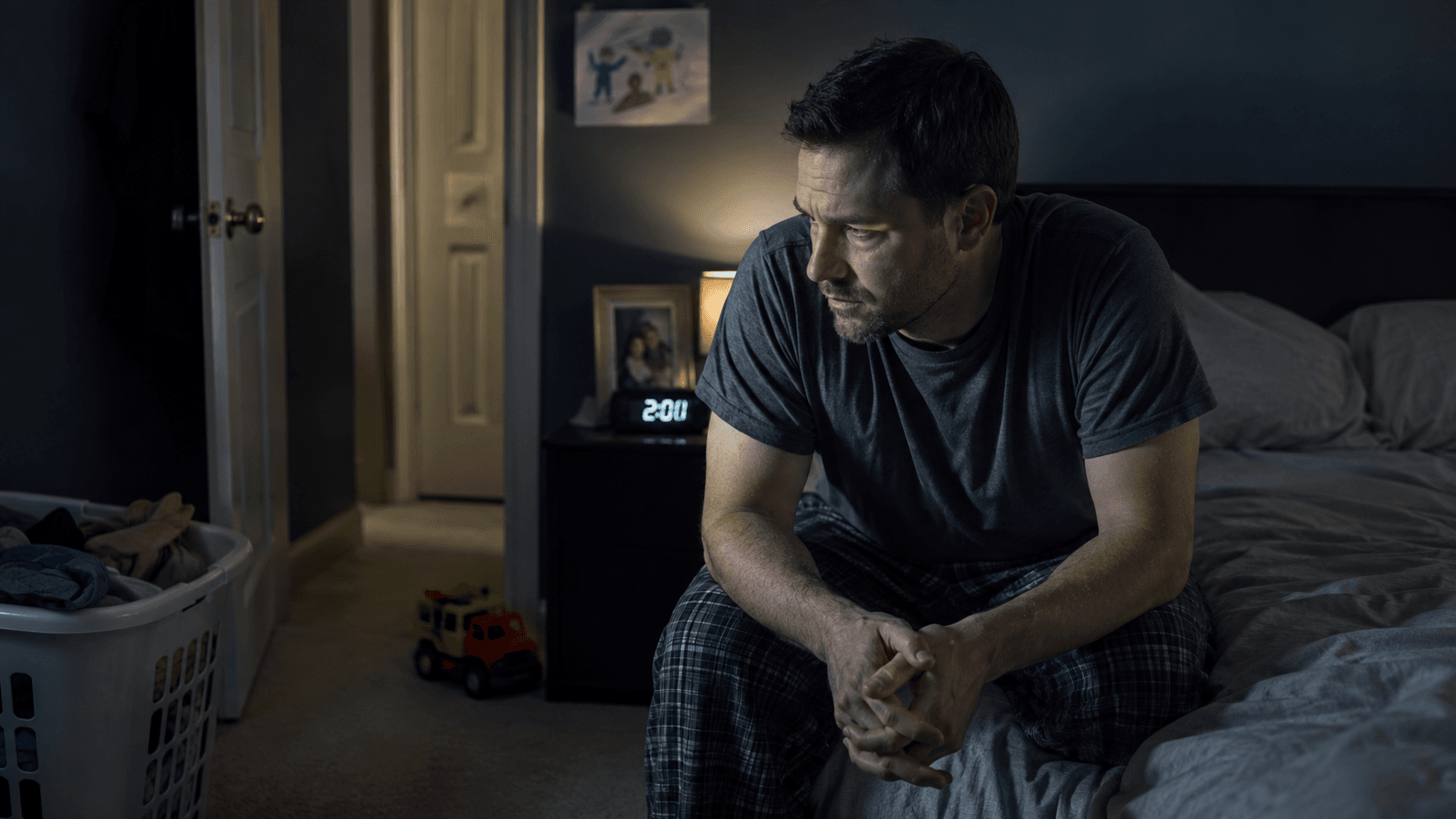
It’s 2 am. The house is quiet in the specific way it only gets at 2 am, and everyone in it is asleep except me. The kids are fine. Down the hall, breathing, fed, safe, tucked under the duvet, one of them will kick off in an hour. Nothing is on fire. No one is sick. The bills are, more or less, paid. And I am lying here with the flat, total certainty that I am failing all of them.
There’s no event attached to it. That’s the part that makes it feel insane. If I’d yelled, or forgotten something important, or watched a school report come back with a note from the teacher, at least the feeling would have a receipt. It doesn’t. It just shows up, sits on my chest, and starts reading me the list. The thing I said at dinner that came out sharper than I meant. The bedtime I rushed because I wanted twenty minutes to myself. The other father at pickup who seems to have all of this handled, who I have invented entirely and now measure myself against anyway.
So here’s the question I stayed up researching after everyone finally went to sleep, which is the only time I do anything: why do I feel like I’m failing as a dad when, by any honest accounting, nothing is actually wrong?
I want to walk through what I found, because it helped. Not a cure. I’m suspicious of anyone selling a cure for this at 2 am. But four things that changed how I hold it: how to name the feeling before I argue with it, why the middle of the night rigs the whole thing, how staggeringly common this is, and the one idea that finally loosened its grip on me at about 3 am.
Key Takeaways
- The feeling of failing is not evidence that you’re failing. Treating an emotion as proof is a common thinking trap that clinicians call emotional reasoning (Canadian Mental Health Association, BC Division).
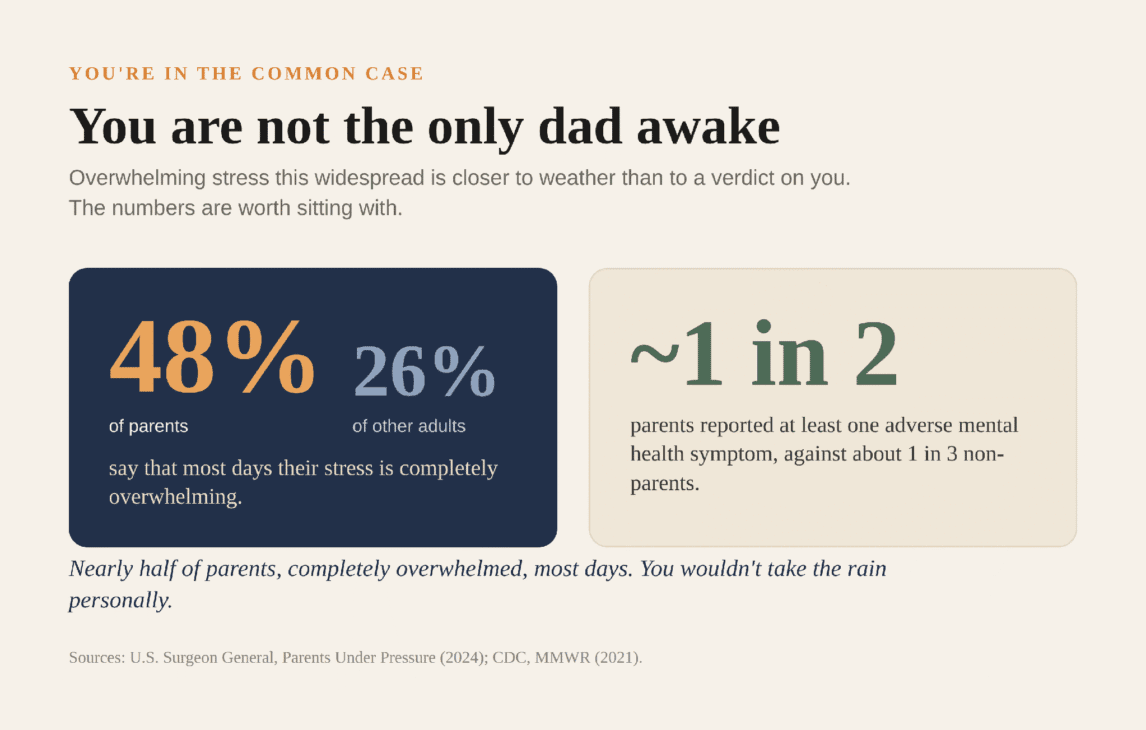
- You have a lot of company. 48% of parents say that most days their stress is completely overwhelming, compared with 26% of other adults (U.S. Surgeon General, Parents Under Pressure, 2024).
- The hour matters. Too little sleep leaves you “less able to cope” (NHS), and lying awake worrying makes it harder to sleep, which produces more worry (NHS inform).
- Fathers tend to carry this in private. Men are less likely than women to have received mental health treatment in the past year (NIMH), and a dad’s distress can surface as anger or withdrawal rather than sadness (CAMH).
- Anxiety is your brain’s “built-in alarm system,” a normal and protective signal (CAMH). It flags that something matters to you, not that something has gone wrong.
- You don’t need to wait to reach out. If the feeling keeps coming back, gets harder to manage, or starts affecting daily life, it’s worth talking to someone (NIMH); the two-week mark doctors use is part of assessing depression, not a waiting period. In Canada, 9-8-8 is there to call or text at any hour.
The Short Answer: Feeling Like a Failure Isn’t the Same as Failing
No. Feeling like you’re failing your kids is not evidence that you are. And the fact that the feeling lands hard at 2am doesn’t make it any more accurate.
I need to separate two things that the middle of the night likes to weld together. There is the feeling of failing, which is real, physical, and currently sitting on your sternum. And there is the fact of failing, which would show up in the actual world, in the actual kids, and which, for most of us most of the time, simply is not there. The feeling is loud. The fact is absent. Your brain, tired and alone, is reading the volume of the feeling as if it were proof of the fact.
There’s a line from a UK hospital’s guide to unhelpful thinking that I keep coming back to, because it’s so plain it’s almost rude. It asks the reader a single question: “Can I recognise that my feelings are not facts?” (Royal National Orthopaedic Hospital NHS Trust, Unhelpful Thinking Styles). That’s the whole hinge of this article. My feelings are not facts. Yours aren’t either. So before we do anything else with this feeling, let’s not believe it yet.
First, Name the Feeling Before You Try to Diagnose It
The instinct at 2 am is to litigate. Am I actually a bad father? Let me review the evidence, your honour, starting with 2019. This is a trap, because you’re exhausted, it’s dark, and you have appointed the feeling as both prosecutor and judge. You will lose.
So try something less ambitious first. Don’t solve it. Name it. What’s here is the feeling of failing. Not the verdict, not the diagnosis, just the sensation, the way you’d note that it’s cold in the room. “I am having the feeling that I’m failing” is a very different sentence from “I am failing,” and the gap between those two sentences is where you get to live.
Naming isn’t a magic trick, and I won’t pretend it dissolves anything. What it does is smaller and more useful. It puts a few centimetres between you and the thing. The NHS, when it talks about handling this kind of night, keeps coming back to the same unglamorous move: “try talking about your feelings to a friend, family member or health professional” (NHS, Stress). Saying it out loud, even to yourself, even into the dark, is the beginning of treating it as something you have rather than something you are. We’ll get to what the feeling might be pointing at. Not yet. First, just let it have a name.
Why This Hits Hardest at 2am (The Timing Is Rigged)
Here’s the part that took the personal sting out of it for me. This feeling has a favourite hour, and it’s not a coincidence. Two ordinary, physical things stack up in the middle of the night to make a passing worry feel like a permanent fact, and neither of them is about the quality of your parenting.
Sleep Loss Turns Down the Part of You That Copes
You are not thinking clearly at 2 am because you are not built to think clearly at 2 am. That’s not a character flaw, it’s physiology. The NHS puts it in the gentlest possible terms: if you regularly don’t get enough sleep, “you may feel tired, irritable or less able to cope” (NHS, Sleep problems). Less able to cope. The exact machinery you’d need to talk yourself down is the machinery that runs low when you’re short on sleep. The National Heart, Lung, and Blood Institute notes that sleep deficiency can leave you having trouble “making decisions, solving problems, remembering things, managing your emotions and behaviour, and coping with change” (NHLBI, How Sleep Affects Your Health).
This isn’t soft science, either. A 2024 review in Psychological Bulletin pulled together more than fifty years of experiments, 154 studies in all, in which researchers deliberately took sleep away from people and measured what happened to their emotions. Across the board, losing sleep reduced positive feelings and increased anxiety (Palmer et al., Psychological Bulletin, 2024). One possible mechanism comes from early brain-imaging research, which described sleep loss as producing a “prefrontal amygdala disconnect,” meaning the calm, reasoning front of the brain loses some of its grip on the brain’s alarm centre (Yoo et al., Current Biology, 2007). Put simply, when you’re tired, the brake can come off the fear.
Now add the fact that you’re a parent, which is to say you are almost certainly already running a deficit. Roughly one in three adults isn’t getting enough sleep to begin with (NHLBI, Sleep Deprivation and Deficiency), and disrupted sleep is something a lot of parents know especially well. So the version of you doing the 2am accounting is the least equipped version of you there is. Of course the numbers come out wrong.
Lying Awake Worrying Is a Loop That Feeds Itself
The second thing is that worry at night isn’t a straight line, it’s a circle. You lie awake because you’re worried, and then you become worried about lying awake, and the two feed each other until the sun comes up. NHS inform, the Scottish health service’s self-help guide, describes the loop almost exactly as it happens: “If you tend to lie awake at night and worry, this can make it difficult for you to fall asleep and stay asleep,” and then people “start worrying about being tired the next day,” which “can make it harder to sleep” (NHS inform, Sleep problems and insomnia). Even chewing on something ordinary keeps you up, because thinking about work projects or big events, even positive ones, “stimulates your mind and can keep you awake.”
The NHS has a word for the going round and round: overthinking, where “you just can’t help going over the same thing again and again,” it “makes you feel anxious and upset,” and it leaves you “struggling to sleep because you constantly have a busy mind” (NHS, Overthinking). Sound familiar. That’s the 2 am ledger, and the ledger has a motive: it needs you awake to keep reading it to you.
I want to be honest about the limits of what I found, because the internet will happily sell you a tidy story about your “night-time brain chemistry” and I couldn’t verify one. There’s no official source I trust that says 2 am has some special dread-producing property all its own. What there is, is this: you’re tired, so your ability to cope is turned down, and you’re caught in a loop that keeps you awake and feeds on itself. That’s not mystical. It’s just enough. It helps explain why the same thought that’s a shrug at 2 pm is a catastrophe at 2 am.
You Are Not the Only Dad Awake Thinking This
If it helps at all, and it helped me, you are not having a rare or shameful experience. You are having an extremely common one, in the dark, where common things feel like personal secrets.
The U.S. Surgeon General thought parental stress was widespread enough to issue a formal public health advisory about it in 2024. The numbers in it are startling. 41% of parents said that most days they were so stressed they couldn’t function, and 48% said that most days their stress was completely overwhelming. Among other adults, those figures were 20% and 26% (U.S. Surgeon General, Parents Under Pressure, 2024). Read that again. Nearly half of parents, completely overwhelmed, most days. The same advisory says the quiet part out loud: parents “shouldn’t have to do it entirely on their own.”
It isn’t only stress, either. In a large U.S. survey, about half of parents reported at least one adverse mental health symptom, against about a third of adults who were neither parents nor caregivers (CDC, MMWR, 2021). That survey ran during the pandemic, so the levels were unusually high, but the gap between parents and non-parents is the part that stays with me. And the Canadian Mental Health Association will tell you that stress itself isn’t the intruder here: it’s “part of being human,” and “if we didn’t feel any stress, we wouldn’t be alive” (CMHA, Stress).
Here’s why I lead with the statistics instead of a pep talk. Nearly half of parents reporting overwhelming stress, most days, tells me something important: struggling under the weight of parenting is common, not a private failing. It’s closer to weather. You wouldn’t lie awake taking it personally that it rained. Feeling crushed by this job is that widespread, and reading it as proof that you specifically are the problem is a category error the darkness encourages.
Why Fathers Feel It in Private (And File It Under “Failing”)
In my experience, a mother in this exact spot is more likely to call a friend, and a father more likely to just lie there. We were, a lot of us, raised to handle it by not mentioning it, and that training doesn’t switch off at 2 am.
The National Institute of Mental Health notes the plain end of this: men are less likely than women to have received mental health treatment in the past year, and men’s distress more often shows up as “anger, irritability, or aggressiveness” than as visible sadness (NIMH, Men and Mental Health). The Canadian Mental Health Association names the cause directly, that men “are often socialized to not talk about their emotions and may mask their stress and deal with emotional pain through harmful behaviours and actions instead of seeking help” (CMHA, How To Support Men’s Mental Health). I suspect a lot of us take the feeling a mum might name as “I’m having a hard week” and quietly translate it into “I’m failing,” or bury it under irritability and a longer day at work.
This is worth saying plainly, because fathers rarely hear it: what you’re feeling is not exotic and it is not weakness. Paternal distress is real and it’s measured. Roughly one in ten fathers experiences depression across the pregnancy and the first year after a baby arrives (CAMH, New Fathers and Mental Health Problems; Paulson & Bazemore, JAMA, 2010). And CAMH makes the point that fathers “may experience significant anger, aggression and addiction to express and cope with distress,” which is to say the sadness often wears a disguise. I’m not diagnosing you from here. I’m telling you that the private, wordless version of this that you’ve been running is the default setting for a lot of us, and a default setting is just a habit, not a fact about who you are.
A Feeling Is Information, Not a Verdict
Here’s the thing that actually moved for me, and it’s less a solution than a change of relationship with the feeling.
I was doing something with a name. When you take a feeling and treat it as proof about the world, that’s emotional reasoning, and it’s one of the most common thinking traps there is. The Canadian Mental Health Association defines it as “believing that bad feelings or emotions reflect the situation” (CMHA, BC). The NHS version is that we “treat our emotions as facts and make conclusions based on how we feel, without considering the actual evidence” (RNOH NHS Trust). That’s it. That’s the whole engine of the 2am spiral. I feel like I’m failing, therefore I am failing. The feeling gets promoted to a fact without ever showing its papers.
So what is the feeling, if it isn’t a verdict? Often it’s a signal, and if anxiety is part of what you’re feeling, that framing is worth holding onto. CAMH describes anxiety as “essentially the ‘Fight or Flight’ response,” the “built-in alarm system that protects us when we perceive a threat or a danger,” and reminds us that “a certain amount of anxiety is normal and necessary” (CAMH, Understanding Anxiety). NIMH agrees that “feeling anxious is a normal part of life” and only becomes a disorder when it “does not go away, is felt in many situations, and can get worse over time” (NIMH, Anxiety Disorders). An alarm is information. It’s your system flagging that something matters to you, not a scoreboard on the kind of father you are.
That distinction is the difference between obeying the feeling and reading it. Obeying it means accepting the verdict and marinating in it until dawn. Reading it means treating it the way you’d treat a warning light on the dashboard: something to notice, and maybe to look into when it’s light out, but not proof that the engine has already died. Before you decide the alarm is real, it helps to know the ways a tired mind fakes the signal. Here are the traps the 2am voice uses most.
| The thinking trap | What it does to you | How it sounds at 2am |
|---|---|---|
| Emotional reasoning | Turns a feeling into evidence about reality | “I feel like a failure, so I must be one” |
| Catastrophising | Jumps to the worst possible outcome and believes it | “One rushed bedtime and I’ve damaged him for good” |
| “Should” statements | Holds you to a standard no rested person could meet | “A good father should never lose his patience” |
| Personalisation | Makes you the sole cause of everything that goes wrong | “If they’re struggling, it’s proof I got it wrong” |
| Mental filter | Keeps only the bad moments and deletes the rest | “Forget the good day, remember the sharp word” |
Source: thinking-trap definitions from the Royal National Orthopaedic Hospital NHS Trust and CMHA, BC; the 2 am translations are mine.
I’m not going to tell you to squash the feeling by 2:15 am. You can’t, and the trying is its own kind of pressure. The move is quieter. When the alarm goes off, you get to ask what it’s actually pointing at, instead of assuming it’s read the verdict correctly and handed down a sentence.
So What Might the Feeling Be Pointing At?
If the feeling is information, it’s fair to ask what information. And usually, when I’ve been honest with myself in the morning, it isn’t pointing at some hidden truth that I’m a bad father. It’s pointing at something more ordinary and more fixable than that.
Often it’s pointing at the fact that I’m exhausted, which we’ve already established makes everything look worse than it is. Sometimes it’s pointing at how alone I’ve been carrying it. And if those nights are part of a broader pattern of loneliness or isolation, that matters more than one bad night. The U.S. Surgeon General went as far as to say that being socially disconnected carries a mortality impact “similar to that caused by smoking up to 15 cigarettes a day,” and that people who often feel lonely have more than double the odds of developing depression (U.S. Surgeon General, Our Epidemic of Loneliness and Isolation, 2023). And sometimes the feeling is pointing at the impossible standard I’ve quietly signed up to, the one where a good father is endlessly patient and never rushes a bedtime and has no needs of his own.
I’m deliberately not turning this into a checklist, because a checklist would be a lie about how this works. But two things are worth naming, not as a cure, as ways to change the soil the feeling grows in. Moving your body genuinely shifts mood, and the CDC notes that physical activity brings “reduced short-term feelings of anxiety for adults” right after a session (CDC, Benefits of Physical Activity). And saying the thing out loud to one actual person, the move we started with, breaks the private loop that the darkness depends on. Neither of these fixes the feeling. They just make it a little harder for the feeling to take hold. That’s allowed to be enough.
When the 2 am Feeling Is More Than a 2 am Feeling
I’ve spent this whole article telling you the feeling isn’t a verdict, and I stand by that. But I’d be failing you in a different way if I didn’t draw the one line that matters, because sometimes the feeling is a signal worth acting on, and the honest thing is to know the difference.
One thing first, because it matters: you do not need to wait two weeks, or hit any threshold at all, before you’re allowed to talk to someone. The timeframes below are part of how doctors assess conditions like depression and anxiety, not a waiting period you have to serve before reaching out. If you think something’s wrong, that’s reason enough.
With that said, the rough test the official guidance keeps returning to is three-part: how long it’s lasted, whether it lifts, and whether it’s bleeding into how you function. NIMH describes depression as symptoms that show up “most of the day, nearly every day, for at least 2 weeks,” and adds that people with fewer symptoms can still benefit from treatment (NIMH, Depression). It defines generalized anxiety as worry that’s “difficult to control” most days “for at least 6 months” (NIMH, Generalized Anxiety Disorder), which again describes the condition rather than the moment you’re permitted to ask for help. CAMH says to seek professional help when “the signs and symptoms of stress have been present for a long period of time,” when “your functioning at work, school, home or socially is affected,” or when “you experience increasing stress and emotional difficulties” (CAMH, Stress). Here’s the same test laid out plainly.
| An ordinary 2 am feeling | Worth talking to someone |
|---|---|
| Shows up on the hard nights, gone by morning | Keeps coming back, or won’t lift for weeks |
| Lifts once you’ve slept and the sun’s up | Doesn’t lift, no matter how much you rest |
| Stays in your head at 2am | Starts affecting work, home, or the people you love |
| A rough patch that passes | A steady weight that keeps getting heavier |
Source: thresholds drawn from NIMH, Depression and NIMH, GAD, and CAMH, Stress.
If you’re on the right-hand side of that table, please treat that as information too, and act on it. Reaching out isn’t the collapse the 2am voice tells you it would be. The Canadian Mental Health Association frames it as the opposite: “we should celebrate the courage it takes to speak up and make changes” (CMHA, How to Get Mental Health Help). Start with your family doctor. And if a night ever tips from heavy into frightening, if you find yourself thinking about not being here, Canada now has a three-digit line, 9-8-8, that you can call or text at any hour, in English or French, led by CAMH (Government of Canada, 2023; 9-8-8 Suicide Crisis Helpline). You don’t have to be in crisis to use it. You just have to be a person who needs to talk to someone tonight.
It’s still 2am as I write the end of this. I’m still awake. Nothing about my life got fixed in the last hour, and I’m not going to pretend it did. But the feeling has changed status while I’ve been sitting here. It’s not a verdict handed down about the kind of father I am anymore. It’s information, sitting on my chest, that I can read properly in the morning when I’ve slept and the light’s back and the alarm centre in my head has someone at the wheel again. The feeling is information. It is not a verdict. That’s not a cure. It’s just the difference between a long night and a life sentence, and tonight, that’s enough to close my eyes on.
About the Author
Vitor Medrado is a Toronto-based writer and creative leader with more than twenty years in advertising, including senior creative roles at Ogilvy, DDB, and Publicis, and recognition at Cannes Lions, the Effies, and D&AD. He writes Dad in Panic from lived experience as a father, not as a psychologist, therapist, or clinician. Read his full bio on the Dad in Panic About page.
How this was made: Vitor wrote, directed, and fact-checked this article against the official sources listed below, with AI assistance used for research and drafting. This piece is a father’s honest account and a summary of public health guidance, not medical advice or a substitute for professional care.
Last fact-checked: August 2026. Mental health guidance is updated over time, so this page is checked against current official sources. If you’re struggling tonight, in Canada you can call or text 9-8-8 at any hour.
Sources
4. Canadian Mental Health Association. Stress.
5. Canadian Mental Health Association, BC Division. Challenge Thinking Traps.
6. Royal National Orthopedic Hospital NHS Trust. Unhelpful Thinking Styles (patient information guide).
7. National Institute of Mental Health (NIMH), National Institutes of Health. Anxiety Disorders.
9. National Institute of Mental Health (NIMH), National Institutes of Health. Depression.
10. National Institute of Mental Health (NIMH), National Institutes of Health. Men and Mental Health.
11. Centre for Addiction and Mental Health (CAMH). Understanding Anxiety.
12. Centre for Addiction and Mental Health (CAMH). Stress (Mental Illness and Addiction Index).
13. Centre for Addiction and Mental Health (CAMH). New Fathers and Mental Health Problems.
15. NHS. Sleep problems (Every Mind Matters).
16. NHS. Stress (Feelings, symptoms and behaviours).
17. NHS (Norfolk and Waveney). Overthinking.
18. NHS inform (NHS Scotland). Sleep problems and insomnia self-help guide.
23. U.S. Centers for Disease Control and Prevention (CDC). Benefits of Physical Activity.
24. Canadian Mental Health Association. How to Get Mental Health Help.
25. Canadian Mental Health Association. How To Support Men’s Mental Health.
26. Government of Canada. Government of Canada launches three-digit suicide crisis helpline, 2023.
27. 9-8-8: Suicide Crisis Helpline. About us.
H2: Frequently Asked Questions
My kids are older now, not babies. Why do I still feel like I’m failing?
The perinatal statistics get the headlines, but nothing about this feeling is tied to a newborn. The standard you’re measuring yourself against, the exhaustion, the comparison to some better father, none of it expires when the kids start school. If anything the ways to fall short seem to multiply as they get older and start noticing more. The feeling isn’t evidence that a specific stage is going wrong. It’s the same old alarm, going off about a bigger kid.
Is feeling like a failing dad a sign of depression?
Not on its own. On a tired, hard night it’s usually just a feeling, and feeling it doesn’t mean you have a condition. What’s worth watching is the pattern. If the low feeling keeps coming back, stops lifting, or starts affecting how you function day to day, it’s worth talking to a professional. Doctors use markers like a low mood most days for two weeks or more when they assess depression (NIMH, Depression), but that’s a diagnostic guide, not a bar you have to clear before reaching out, and NIMH is clear that people with fewer symptoms can still benefit from help.
Why does worry feel worse at night?
Two ordinary things stack up. You’re tired, which turns down the part of you that would normally cope and keep perspective (NHS), and lying awake worrying keeps you awake, which produces more worry, a loop that feeds itself (NHS inform). It’s timing and physiology, not a truer read on your life. The same thought is a shrug at 2pm and a catastrophe at 2am.
Isn’t reaching out just weak? And what if I don’t really have anyone to tell?
The belief that it’s weak is a big part of why so many fathers lie there in silence, and it’s worth retiring. On the practical side, you don’t need a close friend on standby to start. Your family doctor is a legitimate first door, and in Canada 9-8-8 exists precisely so that a person with no one to call at 2am still has somewhere to turn, by phone or text, at any hour. “I don’t have anyone” is a reason to use those, not to stay quiet.
What actually helps in the moment, at 2 am?
Honestly, not much fixes the feeling itself at 2 am, and chasing a fix in the dark just adds pressure. What helps is smaller. Name it as a feeling rather than a fact. Drop the expectation of solving anything before morning. Get what sleep you can. The real work happens in daylight, rested, with a bit of distance. The night is for getting through, not for verdicts.