How Do I Help My Child Feel Okay About Moving to a New Country?

Short answer: The best way to help your child move to a new country is to be the one thing that stays steady while everything else changes. You cannot spare your child the hard part of leaving one country for another, and trying to usually makes it worse. The research on children and hardship keeps landing on the same finding: one steady, committed relationship is the most common thread among kids who come through upheaval intact. That relationship is a job a parent is already built for, even a parent who feels like he is failing at it.
I was standing in a Toronto kitchen that still did not feel like mine, holding a box of cereal I did not recognize, when my son asked me, in Portuguese, when we were going home.
Not home as in upstairs. Home as in São Paulo. Home as in the apartment we no longer had, the avó we had left behind, the light that comes in differently there. He was five. I had moved our entire life across a hemisphere for his future, and I could not explain the move to the one person it was supposedly for.
There is a specific silence that follows a question like that. I am a writer. I have spent twenty years finding words for brands that sell things people do not need. And I stood there with nothing.
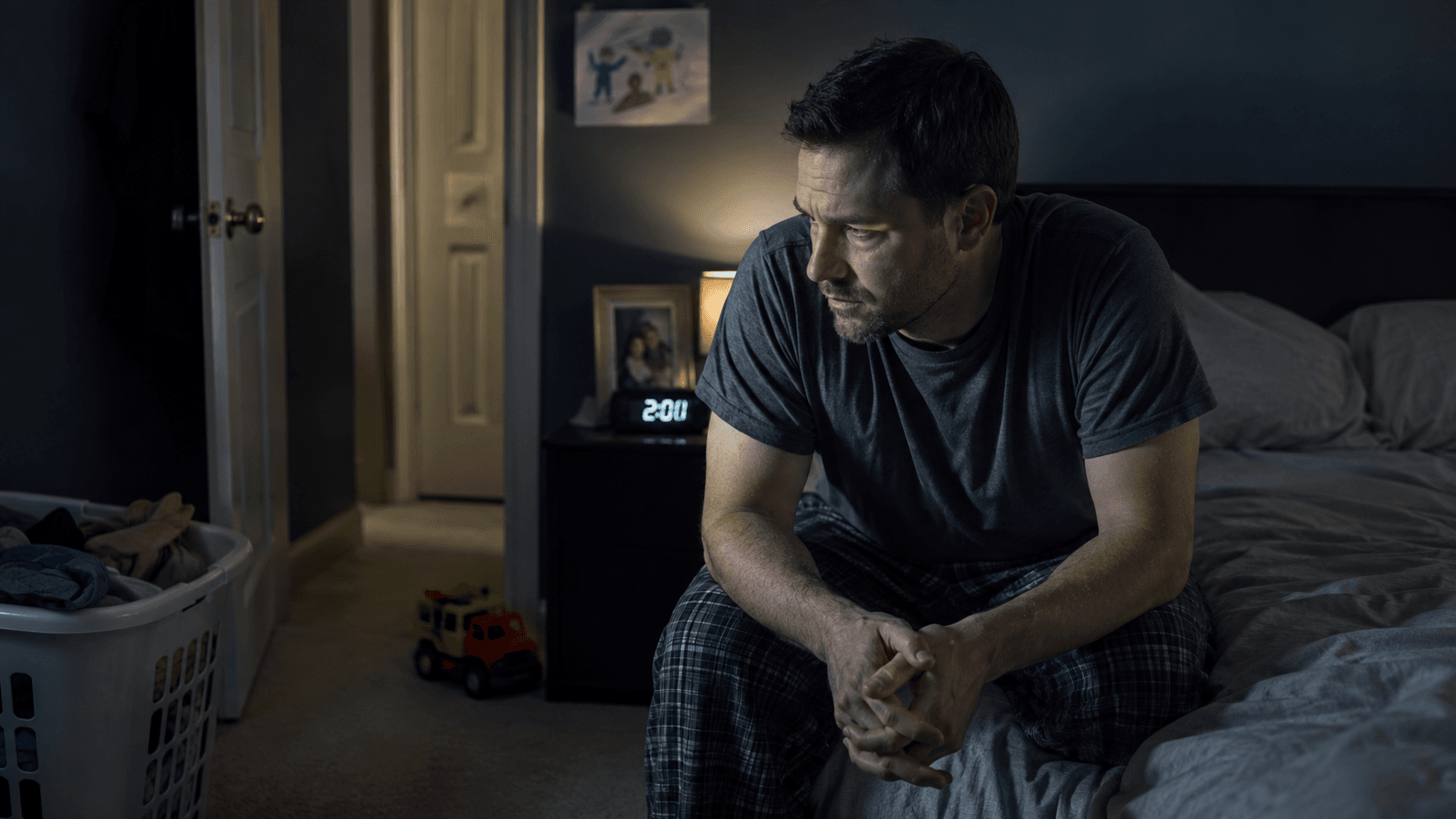
So here is the question I stayed up researching after he finally fell asleep, which is the only time I do anything: how do you actually help a small child feel okay about moving to a new country? Not okay as in cheerful. Okay as in safe.
Below is what the first year really looked like, the things I got wrong while I was learning, the three things that finally helped, and why all of it turned into a book.
Key Takeaways
- Helping your child feel okay about moving to a new country rests on one steady relationship, which the science names as the most common protective factor for a child facing hardship (Center on the Developing Child at Harvard University, Three Principles to Improve Outcomes for Children and Families).
- Expect a dip. The Canadian Paediatric Society puts the hardest, homesick, frustrated stretch in the first six months after arriving, while warning that adjustment is not a fixed schedule (CPS, Adaptation and Acculturation).
- A “silent period” can last roughly three to six months in the new-language setting, where a child goes quiet in the new language while often still talking at home. By itself, it does not indicate a language delay (CPS, Language Acquisition in Immigrant and Refugee Children).
- Early second-language skills usually develop within six months to two years. Reaching a similar oral-language competency to a peer who grew up here can take five to seven years (CPS, Language Acquisition).
- The fastest place to start is small: keep one or two familiar routines steady this week, and when a big feeling lands, name it out loud before you rush to fix it.
The Real Answer: You Can’t Carry Him Over It, but You Can Carry Him Through It
No, you cannot make the move painless, and the goal was never to. A child who leaves everything he knows is going to grieve it, and that grief is not a sign you did something wrong. It is a sign he loved his life. The better question is how to be the thing he can hold onto while he falls.
This is the finding that changed how I parented the whole move. When researchers look at children who come through serious hardship intact, the same factor keeps showing up. In Harvard’s words, “the single most common factor for children who end up doing well is having the support of at least one stable and committed relationship with a parent, caregiver, or other adult” (Center on the Developing Child at Harvard University, Three Principles to Improve Outcomes for Children and Families). Those relationships are “the active ingredient,” the thing that can “buffer children from developmental disruption.”
There is a version of stress that wears grooves into a developing brain, and a version the brain recovers from, and supportive relationships are a big part of what separates the two. They are not the only part. How intense the stress is, how long it lasts, and what else is going on around a child all matter too. But Harvard is clear that when the hard thing is “time-limited and buffered by relationships with adults who help the child adapt, the brain and other organs recover from what might otherwise be damaging effects” (Center on the Developing Child at Harvard University, Toxic Stress). A move is a lot of stress. A present parent is one of the things that helps keep it in the recoverable column. Your presence matters. You just do not control every part of it.
So the pressure lifted a little on the day I understood the assignment. I was never going to make Canada feel like Brazil. I did not have to. I had to be the person Samuel already trusted, out loud and on repeat, while the rest of his world stayed strange for a while. That I could do. On a good day.
What the First Year Actually Looked Like
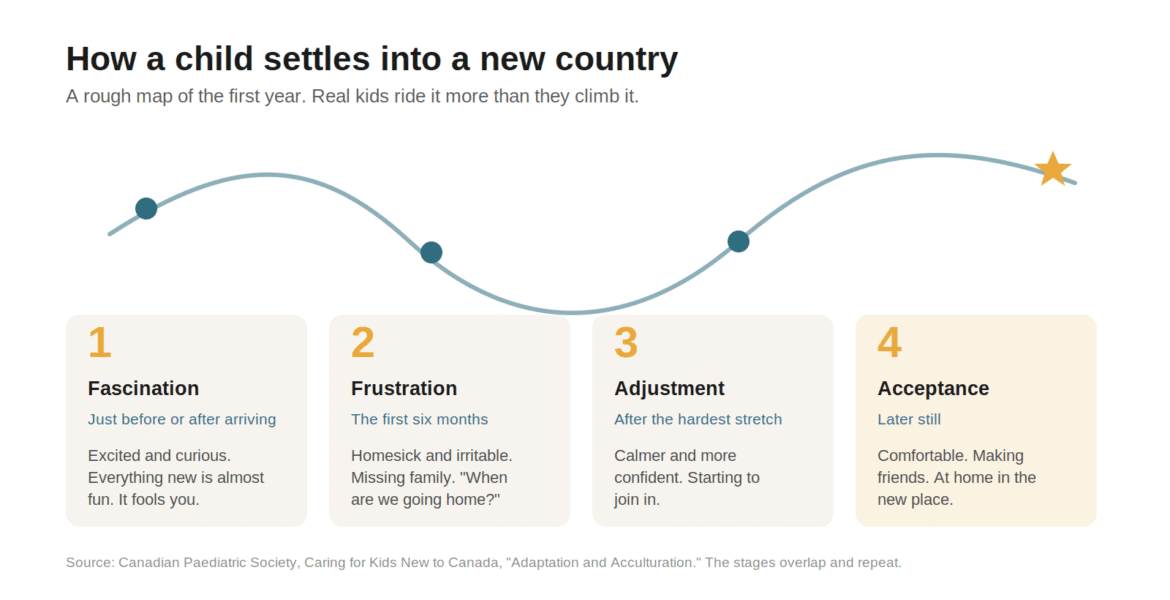
Kids tend to move through a rough shape when they land in a new country, and knowing that shape ahead of time would have saved me about six weeks of quiet panic. Researchers describe adjustment as one possible pattern with a few recognizable stages, not a fixed timetable every child follows, and the Canadian Paediatric Society lays it out plainly for newcomer families, tracing the model back to the sociologist Sverre Lysgaard in 1955 (CPS, Adaptation and Acculturation).
One honest warning before the tidy table: it is not tidy. The CPS is clear that adaptation is “complex and non-linear,” made of “both forward and backward movement, depending on what additional stressors are in the family’s life” (CPS, Adaptation and Acculturation). Samuel did not climb these stages like stairs. He rode them like a kid on a swing that occasionally went backward into a wall.
| Stage | Roughly when | What it can look like in a child |
|---|---|---|
| Happiness and fascination | Just before or just after arriving | Excited, curious, focused on everything new and different |
| Disappointment and frustration | Often in the first six months | Homesick, irritable, missing family, guilty, “when are we going home” |
| Gradual adjustment | After the hardest stretch | Calmer, more confident, starting to join in |
| Acceptance | Later still | Comfortable, making friends, at home in the new place |
Source: Canadian Pediatric Society, Caring for Kids New to Canada, “Adaptation and Acculturation.” This is one possible pattern, not a schedule. The stages overlap, repeat, and run on different clocks for different children.
The First Few Weeks: Everything Is New and It’s Almost Fun
The beginning fools you. In the first stage a child is often excited and wide-eyed, focused on how new everything is (CPS, Adaptation and Acculturation). Samuel thought snow was a personal gift. He pressed the button on every escalator he could reach. The grocery store was the size of a small Brazilian town and he treated it like a theme park.
I let myself believe we had pulled it off cleanly. Look how well he is doing, I told my wife, like a man narrating a film he had not finished watching.
Around Month Two, the Floor Dropped Out
Then the novelty ran out. His experience resembled one pattern described in newcomer research, though every child’s timeline is different: the CPS puts the frustrated, homesick stage in the first six months, and that is roughly when it arrived for us (CPS, Adaptation and Acculturation). Samuel started sliding backward into younger habits. He wanted to be carried again. Bedtime, which we had solved years earlier, became a negotiation with a tiny hostage taker.
These behaviours can show up during a major stress like a move, and their duration, severity, and effect on daily life are what determine when professional advice may help. The American Academy of Pediatrics lists exactly these signs after a big move: “acting and showing behaviours younger than their actual age,” “clinging to adults more than normal,” trouble sleeping, stomachaches, plain irritability (American Academy of Pediatrics, HealthyChildren.org, How Families Can Cope with Relocation Stress After a Disaster). Kids do not always have the words for grief, so they hand it to you as behaviour instead.
There was guilt in there too, which I did not expect from a five-year-old. The CPS notes that “children are often acutely aware of their parents’ sacrifices and may feel guilty” (CPS, Adaptation and Acculturation). Somewhere in his small head, Samuel had decided our sadness was a bill he owed. That one I felt in my teeth.
The Silent Stretch (and Why I Panicked About His English for No Reason)
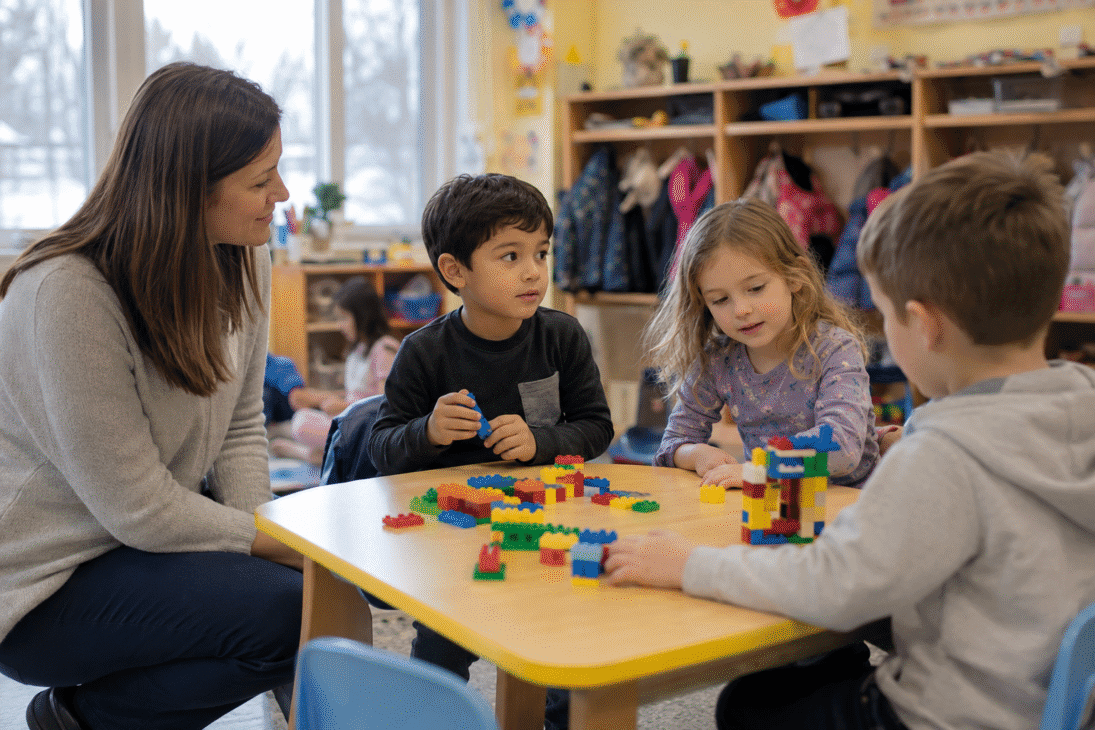
For a few months my son went quiet in English, and I was quietly convinced I had broken him. I had not. A “silent period” is a normal, well-documented stage of learning a second language, where a child goes quiet in the new language, at school and in the new setting, while often still talking away in the home language. The CPS puts it at roughly three to six months (CPS, Language Acquisition in Immigrant and Refugee Children); the U.S. Department of Education describes the same thing lasting “from a few days to a few months” (U.S. Department of Education, Newcomer Tool Kit). He was not falling behind. He was buffering. The one thing worth watching is different: if a child also goes quiet or seems to struggle in their first or strongest language, that is worth raising with a professional, because trouble in the home language is a different signal than quiet in the new one.
Here is the part I wish someone had taped to my fridge. Learning a new language happens on two clocks, and confusing them is how good parents talk themselves into a panic.
| What develops | Approximate timeframe |
|---|---|
| Early second-language skills | Six months to two years |
| Similar oral-language competency to a monolingual peer | Five to seven years for a sequential bilingual learner |
Source: Canadian Paediatric Society, “Language Acquisition in Immigrant and Refugee Children.” Early second-language skills can develop quickly. Reaching similar oral-language competency takes considerably longer.
A child who looks “behind” is often just early on that second clock, and the CPS says so directly: apparent delay has to be weighed against “the length of time of exposure to a second language” (CPS, Language Acquisition). The other thing I got backward: I worried that keeping Portuguese would slow the English down. The opposite is true. The home language is described as playing “a critical role in attachment with family members and in the formation of a strong cultural identity,” and a strong first language actually makes the second one easier (CPS, Language Acquisition). We kept speaking Portuguese at home, loudly and without apology.
The Slow Turn
The turn, when it came, did not announce itself. In the later stages a child grows calmer, more confident, and starts joining in (CPS, Adaptation and Acculturation). For us it was a Tuesday. Samuel came home talking about a boy named Lucas and a game with a specific and complicated set of rules, and he told me the whole thing in English without noticing he was doing it. A week later he corrected my pronunciation of “squirrel,” with the flat confidence of a local. I have never been so happy to be mocked by a child.
There was no finish line, and I have stopped waiting for one. What we got was a turn, and after that year a turn was enough to breathe.
What I Got Wrong
I made those early months harder than they needed to be, and every mistake grew from the same root: I wanted him to feel better faster, mostly so I could feel better faster. Here is where I stepped on the rake, in case you are holding the same rake.
I treated his sadness as a problem to solve. When he cried for Brazil, I countered with reasons Canada was great, like a lawyer. What kids actually need in that moment is permission to feel bad. UNICEF puts it plainly: “allow children to feel sad,” because “expressing sadness is a natural and essential part of coping with stress,” and “listen without judgment” (UNICEF, Laying the foundation for your child’s mental health). I was so busy selling the destination that I skipped the grief he was standing in.
I corrected his English in public. I thought I was helping. I was turning the scariest new thing in his life into a test he could fail in front of strangers. The CPS guidance on stressful times is the opposite of a pop quiz: check in, but “don’t force your child to talk until they are ready” (Caring for Kids, CPS, Helping children and teens cope with stressful public events).
I packed the Brazil stuff away to help him “move on.” His familiar blanket, the little worn things from the old apartment, all tidied into a closet so the new place could feel like a fresh start. That was exactly backward. The AAP describes comfort objects as the thing that helps a child in a strange place feel at home: “when they’re in a strange place, it will help them feel at home,” and there is “no reason to keep your child from using one” (AAP, HealthyChildren.org, Transitional Objects). I dug the blanket back out that night.
And I hid my own stress so well that he had no map for his own. I thought a calm face meant a calm kid. But children read us, and the CPS notes a child “will learn from your response and may feel better knowing they’re not the only one who is worried” (Caring for Kids, CPS). The day I admitted, out loud, that I missed home too, something in his shoulders came down.
The Three Things That Actually Helped
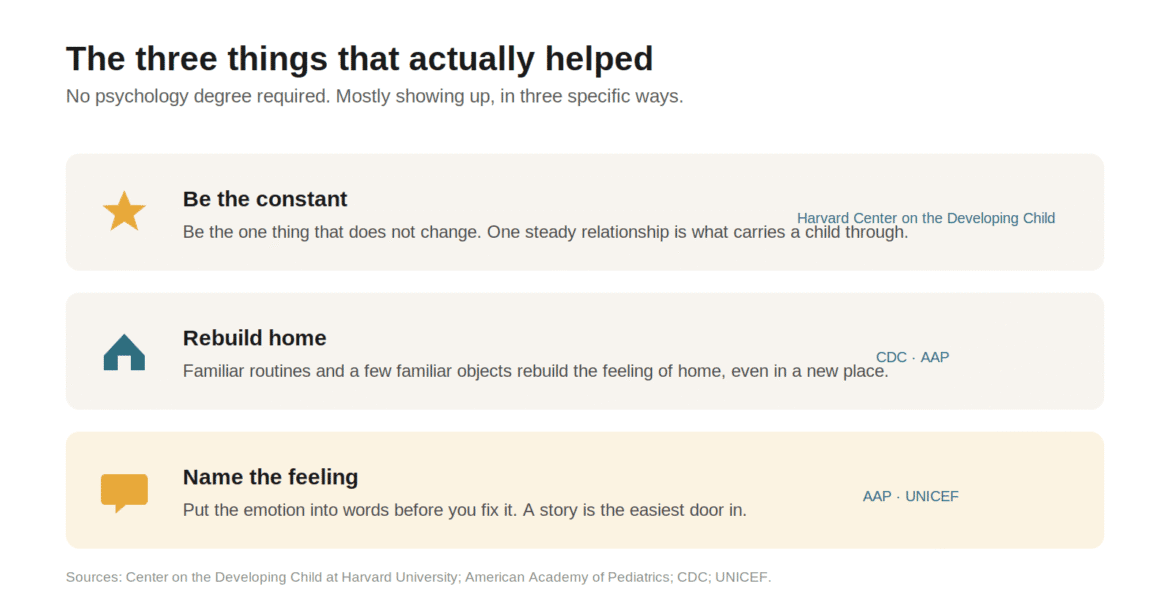
After all the trial and error, three things did the real work. None of them need a psychology degree, and none of them need you to be a naturally calm person, which was lucky for me. They mostly need you to keep showing up in a couple of specific ways.
One: I Stopped Trying to Fix It and Started Being the Constant
The single most useful thing I did was become boring and reliable on purpose. When everything in a child’s world is new, you get to be the fixed point, and that fixed point is what the whole recovery hangs on.
Young children build their sense of safety through “serve and return,” the ordinary back-and-forth where a child reaches out and a trusted adult responds (Center on the Developing Child at Harvard University, Serve and Return). The CPS is blunt about how much this one relationship carries: “the parent-child relationship is the one that most strongly affects emotional and behavioural functioning,” and “a secure attachment relationship with at least one healthy adult is essential for a child to develop optimal coping abilities” (CPS, Relationships matter: How clinicians can support positive parenting in the early years).
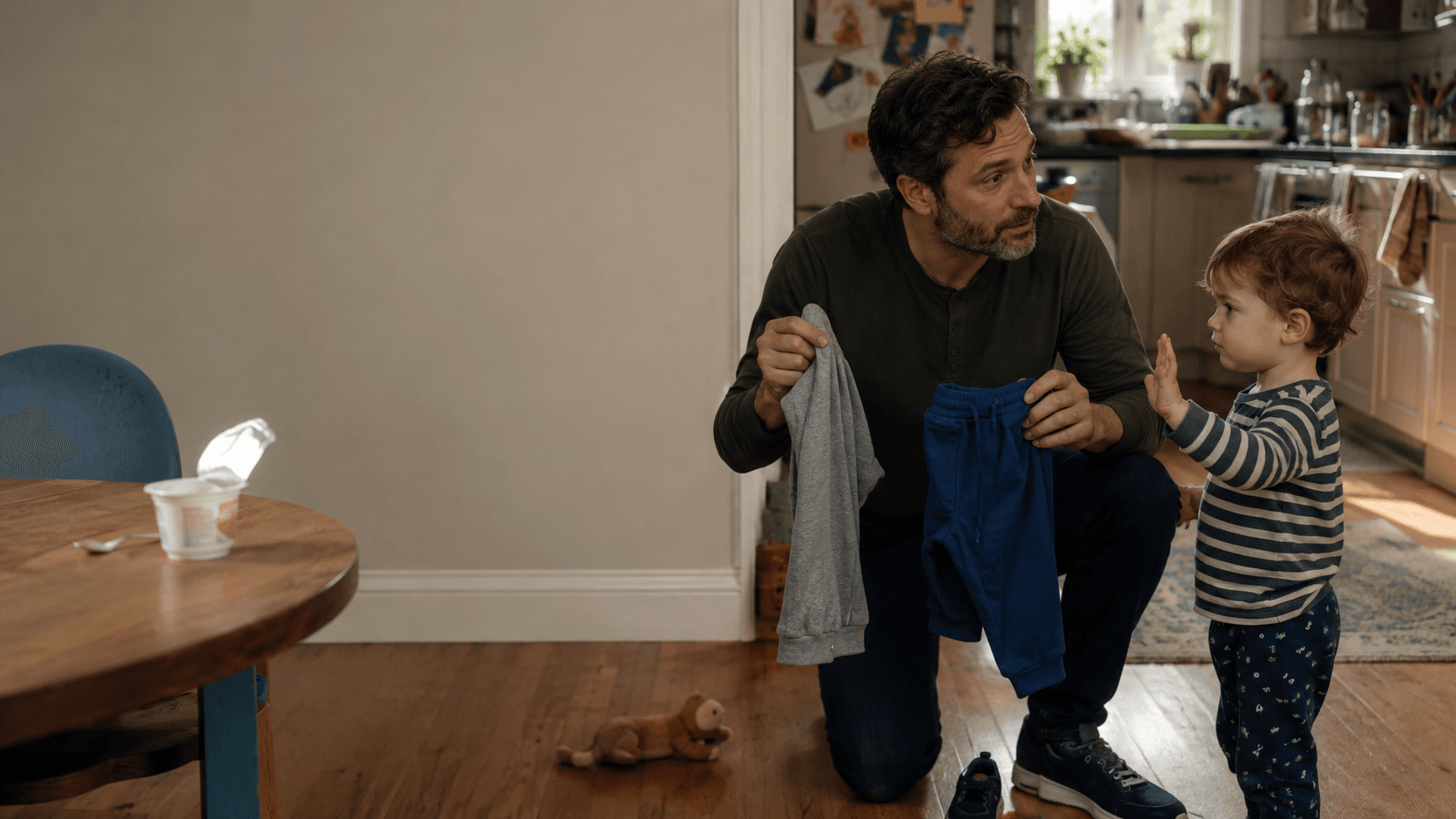
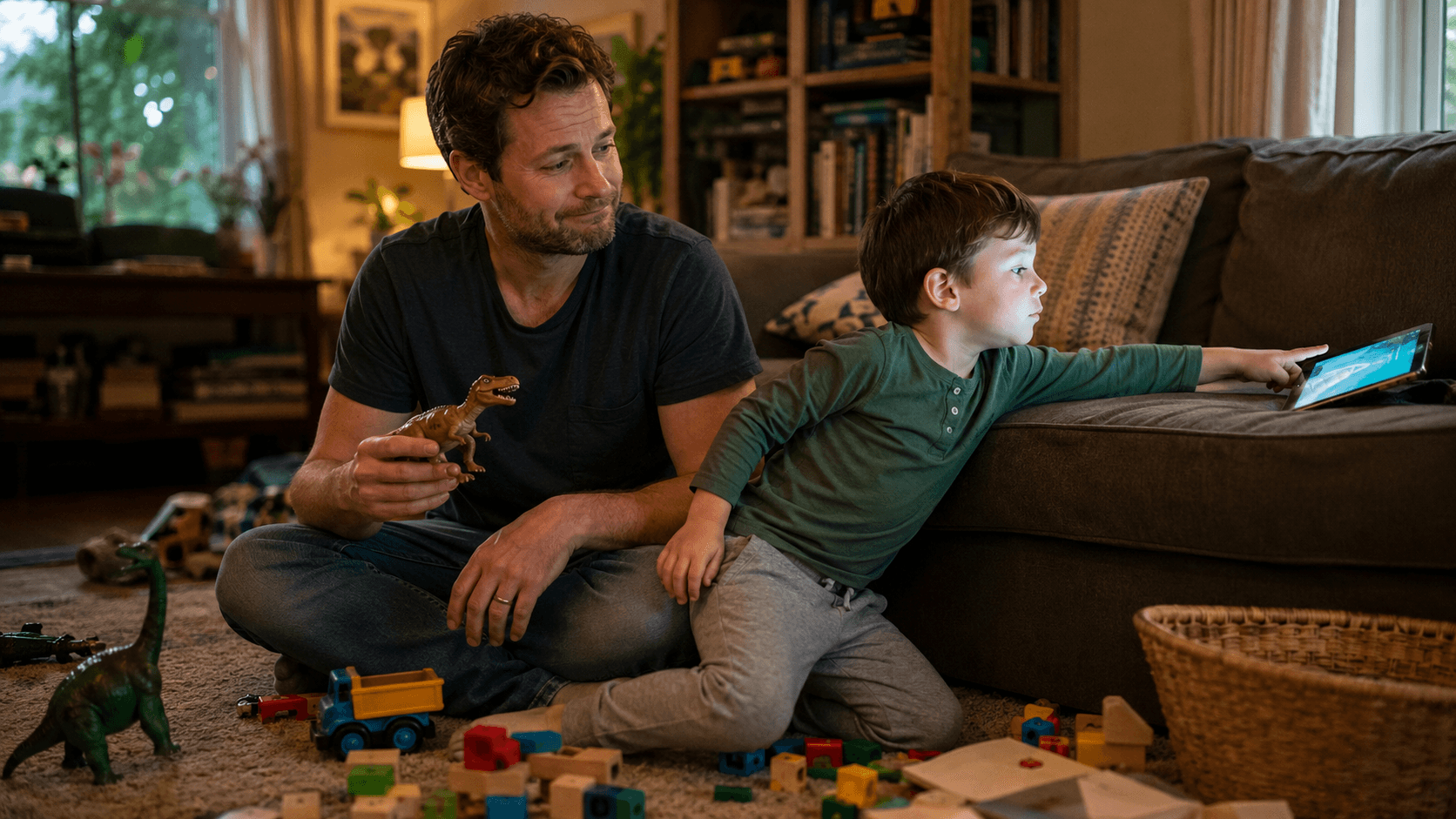
In practice this looked painfully simple. More time on the floor. More eye contact when he talked, even about nothing, especially about nothing. The same goodbye, the same greeting, the same dumb song in the elevator, every single day, so that in a country full of surprises I was the one thing he could predict.
Two: We Rebuilt “Home” Out of Small, Repeatable Things
Home for a small child is not an address. It is a set of things that happen in the same order. So we stopped chasing a big feeling of belonging and rebuilt it out of tiny, repeatable ones.
Predictable routines are not a nice-to-have here. The CDC puts it simply: “kids feel safe and secure because they know what to expect” (Centers for Disease Control and Prevention, Essentials for Parenting Toddlers and Preschoolers). After a move in particular, the AAP says “restoring daily routines helps build a sense of being home mentally and emotionally, even in the absence of a physical home,” and points to exactly the small stuff, “family walks” and “bedtime stories,” as the things that “help pull the pieces of daily life back together even in a new place” (AAP, HealthyChildren.org, How Families Can Cope with Relocation Stress After a Disaster).
We kept Brazil alive on purpose, and we let Canada in at the same time. There is good evidence for holding both at once. The CPS encourages newcomers “to integrate by maintaining their culture of origin while actively participating in Canadian society,” and calls “cultural connectedness” an “important protective factor for youth” (CPS, Adaptation and Acculturation). So there were Sunday calls with his grandmother, which is really just the AAP’s advice to keep a child connected to family, friends, and news of home (AAP, HealthyChildren.org, How Families Can Cope with Relocation Stress After a Disaster). There was also his old blanket, back where it belonged. Small anchors, dropped everywhere.
Three: We Gave the Feeling a Name
A five-year-old drowning in a feeling he cannot name will hand it to you sideways, as a tantrum or a stomachache. The move that changed our nights was almost embarrassingly small: I started naming the feeling for him, out loud, before I did anything else.
The AAP calls this putting the emotion into words, literally: “You look mad/angry/scared/disappointed/frustrated” (AAP, HealthyChildren.org, Healthy Mental & Emotional Development). It starts with noticing the feeling, then naming it and acknowledging it, which is what “helps children feel safe and secure in the moment” (AAP, HealthyChildren.org, Helping Little People Manage Big Feelings). “You miss Brazil, and you are angry that we live here now” did more for a bedtime than any pep talk I ever attempted.
The problem is that a scared kid will not sit still for a feelings conversation. So we smuggled it in through stories. This next part is my own experience more than a proven prescription, but it lines up with what people who study children’s books describe. A picture book gives a child a safe way into a hard feeling, because the fear belongs to the character first. Gentle stories, as the literacy service Colorín Colorado puts it, “offer an entry point for talking about topics like moving” and “changes” (Colorín Colorado, Books for Kids: When Things Change), and, as the literacy scholar Maria Nikolajeva writes, picture books tend to hand children “a straightforward label for the emotion dealt with in the book” so they can recognize it later in themselves (Maria Nikolajeva, “Picturebooks and Emotional Literacy,” The Reading Teacher, 2013). We would read about a character who was scared and far from home, pause, and I would ask if he ever felt like that. He always did. The book asked the question I could not.
How Do I Know If This Is Normal or If My Child Needs More Help?
Some of what looks alarming in the first months is a normal stress response that eases as your child settles. What helps is knowing which changes are usually part of settling in, and which ones are worth a professional’s eyes, and the difference is less about the behaviour itself than about how long it lasts, how severe it is, whether it is getting worse, and whether it is getting in the way of daily life. The research on newcomer children’s outcomes is still limited, but the CPS reports the reassuring baseline that “most newly-arrived immigrant children do well in school,” and several newcomer groups end up doing better than their Canadian-born peers (CPS, School and Education). It also helps to know how much company you are in. According to the 2021 census, almost 1.9 million Canadian children under fifteen, about 31.5 percent of all children in the country, had at least one foreign-born parent (Statistics Canada, 2021 Census). That figure counts family background, not children who themselves moved countries, but the point holds: a home shaped by immigration is one of the most ordinary things about growing up here. Your child is not the only one figuring this out, and neither are you.
The signs themselves are not the alarm. The timing, severity, and direction are. The line the CPS draws is whether the difficult behaviours “last for a while” or “interfere with your child’s ability to function,” and, importantly, “just because you notice one or more of these changes does not mean your child or youth has a mental health problem” (Caring for Kids, CPS, Your child’s mental health).
| Usually part of settling in | Worth a conversation with your doctor |
|---|---|
| Homesickness, missing family, tearfulness in the first months | Sadness or withdrawal that lasts a long time and does not ease |
| Clinginess, some sleep trouble, slipping into younger habits | Behaviour that keeps your child from functioning day to day |
| Going quiet in the new language for a few months | Trouble that gets worse over time instead of slowly better |
| Big feelings that pass with comfort and routine | Any talk of self-harm, which means getting help right away |
Source: Caring for Kids, Canadian Paediatric Society, “Your child’s mental health.” The rows on the right are drawn from CPS guidance; the reassuring baseline on the left reflects CPS and AAP guidance taken together.
If your child ever talks about suicide or hurting themselves, treat it as urgent, not as a stage to wait out. In Canada you can call or text 9-8-8, the Suicide Crisis Helpline, any time of day, and call 9-1-1 if there is immediate danger (Government of Canada, 9-8-8: Suicide Crisis Helpline).
You know your child better than any table does. If your gut says something is off, that is a good enough reason to ask a professional. Asking is not an overreaction. It is just parenting with backup.
What to Try This Week (Small Moves, Not a Personality Transplant)
You do not need a new philosophy of childhood. You need a few small changes so your child has something steady to stand on, and each one below comes straight from official guidance.
- Guard the routines. Protect two or three familiar routines and treat the bedtime story as sacred, because predictable rhythms are what tell a child he is safe (CDC, Essentials for Parenting).
- Keep the home language going. Speak your first language at home without apology; it strengthens the bond and, as it turns out, the new language too (CPS, Language Acquisition).
- Name the feeling first. When the big feeling shows up, say what it is out loud before you try to fix it (AAP, Helping Little People Manage Big Feelings).
- Leave the familiar things out. Keep a couple of comfort objects in the open instead of packed away (AAP, Transitional Objects).
- Book the call home. Set up a regular call with the people back home so the old world does not just vanish (AAP, How Families Can Cope with Relocation Stress After a Disaster).
- Go easy on yourself. A calm-enough parent does more for a scared child than any perfect plan (Caring for Kids, CPS).
None of this makes the move painless. It just gives your child a few fixed points to hold while everything else is still strange.
The Reason This Turned Into a Book
I could not find the words to explain to a five-year-old why his entire world had picked up and moved, so I did the only thing I actually know how to do. I put it in a story.
That is where “The Little Star Who Landed in the Ocean” came from (available on the Dad in Panic books page), the English edition of a book I first wrote in Portuguese. It is about a small star that ends up somewhere it never expected, in unfamiliar water, having to figure out how to shine when nothing around it looks like home. The site’s own line for it is honest about what it is for: “a story about feeling out of place, and finding your light anyway.”
I wrote it so a child who feels out of place has a character to hand the feeling to, and a parent who is out of their depth has a door into the conversation. The book was never really the point. The point is the lap it gets read on, the pause after a hard page, the small voice asking if the star is going to be okay, and a father getting to say yes, because I am right here.
That, in the end, is the whole answer to the question. You help your child feel okay about moving to a new country by refusing to disappear from it. The rest you figure out together, as you go.
About the Author
Vitor Medrado is a Toronto-based writer and creative leader with more than twenty years in advertising, including senior creative roles at Ogilvy, DDB, and Publicis, and recognition at Cannes Lions, the Effies, and D&AD. Today he works in creative strategy and AI integration, and he writes Dad in Panic from lived experience as a father who moved his family from Brazil to Canada, not as a clinician or parenting expert. Read his full bio on the Dad in Panic About page.
How this was made: Vitor wrote and fact-checked this article against the official sources listed below, with AI assistance used for research and drafting.
Last reviewed: August 2026. Guidance on children and migration can change, so this page is checked against current official sources.
Sources
Canadian Paediatric Society, Caring for Kids New to Canada. Adaptation and Acculturation.
Canadian Paediatric Society, Caring for Kids New to Canada. School and Education.
Canadian Paediatric Society, Caring for Kids. Your child’s mental health, 2018.
Center on the Developing Child at Harvard University. InBrief: The Science of Resilience, 2015.
Center on the Developing Child at Harvard University. Toxic Stress.
Center on the Developing Child at Harvard University. Serve and Return.
UNICEF Europe and Central Asia. Laying the foundation for your child’s mental health.
U.S. Department of Education, Office of English Language Acquisition. Newcomer Tool Kit, Chapter 4.
Colorín Colorado (WETA). Books for Kids: When Things Change.
Government of Canada, Public Health Agency of Canada. 9-8-8: Suicide Crisis Helpline.
Frequently Asked Questions
We haven’t moved yet. Should I prepare my child ahead of time, or will talking about it early just cause worry?
Prepare them, in small and honest pieces. Young children feel safer when they know what to expect, so bring the move up at a calm moment when your child can actually take it in, not in the middle of chaos (CDC, Essentials for Parenting). Let your child pack a little bag of their own favourite things to carry into the new place, because those familiar objects are exactly what help a child feel at home somewhere strange (AAP, Transitional Objects).
Does a big move affect a younger child differently than an older one?
Yes, in different shapes. Younger children tend to slide back into earlier habits, get clingier, and struggle to put the change into words, while older kids are more likely to show it as anger, worry, or pulling away (AAP, How Families Can Cope with Relocation Stress After a Disaster). Same grief, different vocabulary. Respond to the child in front of you rather than the age on paper.
What should I tell my child’s new school or teacher?
Tell them your child is new to the country and still settling, and ask how the school supports newcomer kids. A supportive relationship with a teacher helps a young immigrant feel a sense of belonging, and English-as-a-second-language support improves how newcomer children do academically (CPS, School and Education). If you get a choice, a school with other newcomer families tends to make the landing softer.
Should I push my child to make friends, or let them take their time?
Give it time, and let play carry the load. Children who were anxious about starting preschool were twice as likely to feel less stressed after just fifteen minutes of play as classmates who sat and listened to a story (AAP, The Power of Play). Set up low-pressure chances to play near other kids and let friendship happen on your child’s clock, not on yours.
Is it normal for only one of my kids to struggle while the others seem fine?
Completely. No two children settle the same way, and the research describes adjustment as non-linear, full of forward and backward movement depending on everything else going on in a family’s life (CPS, Adaptation and Acculturation). One child sailing through while another has a hard time says nothing bad about either of them. Meet each one where they actually are.