Parenting in the Age of AI: What Dads Can Actually Do

A few weeks ago I opened a chatbot and typed a completely genuine question: how do I protect my kid from AI? My son was standing right beside me while I did it, watching his father ask a robot for help defending him against robots. He is six. He thought it was the funniest thing he had seen all week. I thought it was a little too honest.
So let me say the reassuring part first, because I badly needed someone to say it to me. You do not have to understand how these models work to be a good dad in the age of AI. You do not have to beat your kid at the technology. What you need is a handful of clear, age-appropriate rules, and you can start setting them tonight.
Here is the short version, before the detail. Parenting in the age of AI means protecting three things: how your child thinks, what they share, and who they turn to when something matters. Use AI together, protect the first attempt, verify important answers, keep personal information private, and take emotional or urgent problems to a real person.
That is the job. Everything below is the detail, the evidence I went and read after everyone was asleep, and a few things I got wrong first so you can skip them.
Key Takeaways
If you read nothing else on this page, read these five.
- About 38% of the children in a UNICEF issue brief, published in 2026 and based on surveys completed through early 2025, had used generative-AI tools. Only 12% of their parents had. That gap is the real starting point, and it argues for guidance rather than a blanket ban.
- Among the kids who used AI, 60% used it for homework, per the same UNICEF brief. Homework that looks better is not proof a child learned anything, a distinction the OECD Digital Education Outlook 2026 draws carefully.
- 11% of child AI users had asked it for advice about things worrying them, UNICEF found. That is why emotional boundaries and real human support have to be said out loud in a family, not just assumed.
- UNESCO recommends age 13 as a minimum for independent classroom use or independent conversations with general-purpose generative AI. It is international policy guidance for education settings, not a Canadian law, and not a promise that a particular 13-year-old is ready.
- You can start a family agreement tonight. It begins with one question: ask your child how they already use AI, then agree together on purpose, privacy, checking facts, and when to bring in a person.
Parenting in the Age of AI Starts With a Better Question

For about a month, my project was raising an AI-proof kid. I wanted him sealed against every tool that has not been invented yet. It felt responsible. It felt like control. It was also impossible, and the harder I chased it, the worse I got at the parts of fathering that were right in front of me.
The goal I landed on is smaller and does more work. I want my son to keep learning, to weigh what he reads, to stay close to real people, to make things that are his, and to use AI without quietly handing over his thinking, his privacy, or the relationships that hold him up. That aim does not expire when the next model ships. It also happens to match what the big institutions recommend once you get past the headlines, from UNICEF’s guidance on AI and children to the OECD’s 2026 review of AI in education.
What Parenting in the Age of AI Actually Means
Here is the plain-language version. Parenting in the age of AI means teaching your child when to reach for AI, when to question what it hands back, and when to shut the laptop and talk to a human. Nobody is asking you to predict the tools of 2040, which is fortunate, because none of us can.
In practice it comes down to five habits: guided use instead of either a free-for-all or a total ban, enough AI literacy that a child knows what the tool is and is not, privacy awareness, the confidence to think first before outsourcing, and steady human relationships underneath all of it. Every recommendation later on this page is one of those five habits applied to a specific age or a specific mess.
What the Evidence Still Cannot Tell Parents
I want to be honest about the limits before I start making recommendations, because a lot of what gets shared about kids and AI is louder than the evidence behind it. The truthful position is that the long-term cognitive, psychological and social effects of growing up with generative AI are still poorly understood, and UNICEF says so plainly in its guidance.
So here is my rule for this whole article. Where the evidence is solid, I will say it plainly. Where it is early, I will say may, or can, or raises a concern, and I will mean it. You will not catch me claiming that using a chatbot stops a child’s brain from wiring itself, because no official source I could find supports that, and I nearly repeated it before I checked. A reduced chance to practise a skill is real and worth managing. A permanently broken brain is a scare story.
Kids Are Already Using AI More Than Many Parents Realize

Before we talk about rules, it helps to know this is already happening in your house, or will be soon, and that the adults are usually a step behind. That is not a criticism. It is just the current shape of things.
What UNICEF Found About Children’s AI Use
The clearest recent snapshot comes from a UNICEF issue brief, published in 2026 and based on nationally representative household surveys completed through early 2025 across ten countries. One caveat up front, because it matters: those surveys covered internet-using children aged 12 to 17 in Armenia, Brazil, Colombia, the Dominican Republic, Jordan, Mexico, Montenegro, North Macedonia, Pakistan, and Serbia. They do not describe every child on earth, and they asked about generative-AI tools specifically.
| The finding | What it means for you | The caveat |
|---|---|---|
| 38% of surveyed children had used generative-AI tools; 12% of parents had. | There is often a real knowledge gap inside a single household. | These ten countries do not represent everywhere. |
| 60% of child users used AI for homework; 47% to find information. | Homework was the most commonly reported use among the surveyed child users. | Use does not tell us whether learning improved. |
| 11% of child users asked AI for advice about things that worried them. | Some kids already lean on AI in emotionally sensitive moments. | This is reported use, not proof of dependency or harm. |
| Children were more than three times as likely as their parents to have used AI. | Parents often do not know the tools their kids already use daily. | The direction of influence inside families is still unclear. |
All four figures come from that same UNICEF issue brief, published in 2026 from surveys completed through early 2025.
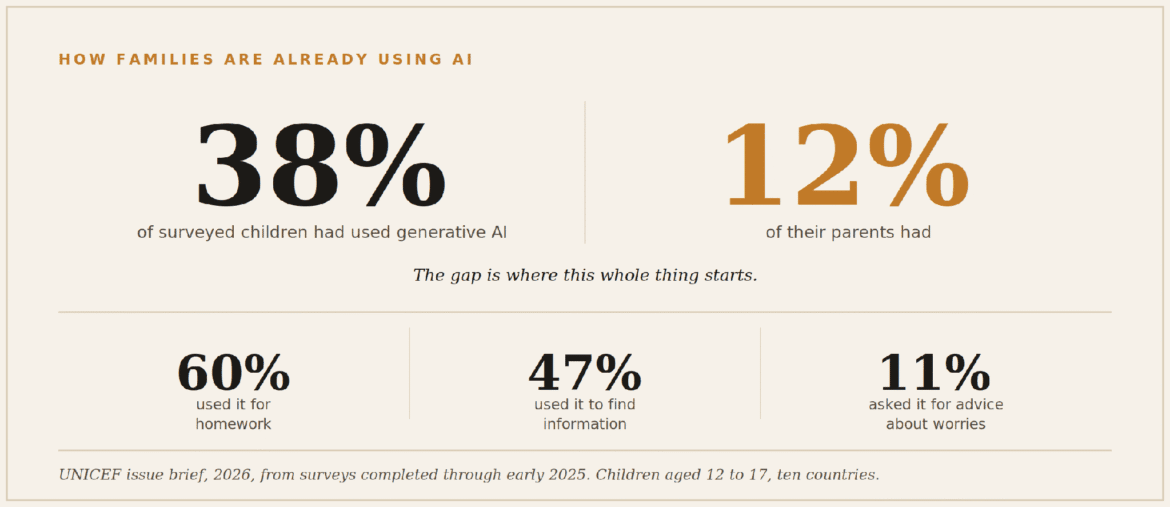
Source: UNICEF issue brief, published 2026, based on surveys completed through early 2025. Ten countries, internet-using children aged 12 to 17.
Why Guidance Works Better Than a Blanket Ban
My instinct, the first time I saw those numbers, was to ban everything. It is the wrong instinct, and, gently, the evidence agrees. UNICEF’s broader digital-parenting research supports co-learning: your kid shows you how the tool works, while you bring judgement, values, and an understanding of risk.
There is a nuance in the survey worth stating carefully. Children who reported more parental restrictions were less likely to report previous AI use. That is an association, not proof that restriction caused anything, and the same brief warns that over-restriction can also cut a child off from useful tools and the digital skills that come with them. So instead of aiming for zero access, aim for the kind of access you can see and talk about.
The Future of Work Is Changing, but Nobody Has the Map
A lot of AI parenting anxiety is really job anxiety wearing a costume. We are scared our kids will train for a career that evaporates. Fair. But the honest labour-market picture is messier and less doom-laden than the headlines, and messy is much easier to parent than doom.
What 39%, One in Four and 60% Really Mean
Three numbers get quoted constantly, usually mashed together into one scary total. They measure different things and should never be added up. Here is each one standing on its own.
| The figure | Who measured it | What it measures | What it does not mean |
|---|---|---|---|
| 39% of core skills | World Economic Forum | Employers expect 39% of workers’ core skills to change by 2030. | It does not mean 39% of jobs disappear. |
| One in four workers | ILO | About one-quarter of workers worldwide are in occupations with some exposure to generative AI. | Exposure means tasks may change, not that the job vanishes. |
| 60% of employees | Statistics Canada | An experimental estimate that about 60% of Canadian employees could see some AI-related job transformation. | Roughly half of that group is in roles that may be highly complementary with AI, not replaced. Exposure is not unemployment. |
The three come from different populations and different methods. Add them or average them and you produce a number that means nothing at all. The Statistics Canada figure is an experimental occupational-exposure estimate for employees aged 18 to 64, drawn from 2016 and 2021 Census data, and exposure is not the same as unemployment.
Skills That Remain Valuable Alongside AI
Once you stop trying to name the exact future job, a better question shows up: what stays useful across a lot of possible futures? The World Economic Forum’s employer survey keeps pointing at the same cluster, and the good news for tired parents is that most of it is built at home, not in a coding camp.
| What employers keep valuing | What it looks like at home |
|---|---|
| Analytical and creative thinking | Ask for reasons, alternatives and evidence. Make things that have no single correct answer. |
| Resilience, flexibility and self-awareness | Let effort and repair stay visible. Change course after a mistake where your kid can watch you do it. |
| Empathy, active listening and working with people | Practise disagreeing, listening and taking responsibility in real relationships, starting with yours. |
| Curiosity and lifelong learning | Treat not knowing as where learning starts, not as a failure to hide. |
| Technological and AI literacy | Show what AI can do, where it fails, and when not to use it at all. |
Those home translations are my practical reading of the WEF clusters, not the Forum’s own wording.
The Biggest Learning Risk: Better Work Without Better Learning
If you take one idea from this whole page into your kid’s next homework session, take this one. It is the strongest, best-supported finding I came across, and it quietly answers the homework question every parent has.
How Cognitive Offloading Can Reduce Practice
AI can make an assignment look better without helping your child do a similar task on their own. The OECD’s 2026 education review found that students can produce stronger work with general-purpose AI without developing gains that transfer to unaided assessments. In some studies, the performance advantage disappeared or reversed when students completed assessments without AI.
The mechanism has a boring name: cognitive offloading. It just means the tool did the thinking, writing or remembering your child needed to practise. A calculator does the same thing with arithmetic, which is fine once the arithmetic is learned and a problem when it never was. The risk is simple. The practice your kid needed to build the skill got skipped, and nobody noticed because the output looked great.
When AI Can Improve Learning
The same OECD review refuses to hand you a tidy anti-AI conclusion, and I respect it for that. When AI is purpose-built or carefully guided, it can really help: tutoring, feedback, argument practice, collaboration, creativity, and access for kids who need support to take part at all. The logo matters less than the learning design: does the tool support the thinking, or quietly do it instead?
The Think-Use-Check-Rebuild Method
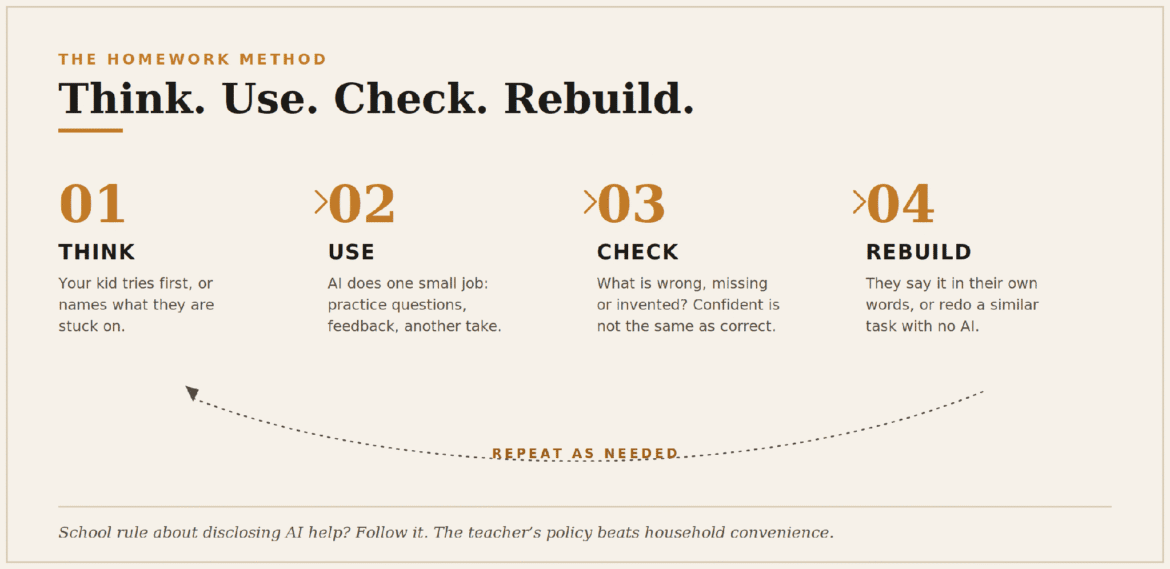
I needed all of that as one thing I could hold in my head at 8 p.m. with a tired child. So here it is, four steps.
- Think first. Your child attempts the task, states an idea, or names exactly what they do not understand.
- Use AI for one bounded job. Generating practice questions, comparing two explanations, or giving feedback on a draft.
- Check the output. Ask what might be wrong, missing, biased, or invented. Assume it is confident and occasionally incorrect.
- Rebuild it alone. Your child explains the answer in their own words, or does a similar task with no AI at all.
One line lives outside the loop: if the school has a rule about disclosing AI help, follow it. The teacher’s policy comes before household convenience.
That sequence is a practical reading of learning and human-agency guidance from UNESCO and UNICEF. It is a household routine, not a clinical protocol.
AI Is Not the Same as Screen Time
When I first panicked about this, I reached for everything I had ever read about screen time and tried to staple it onto AI. It mostly does not fit. Some of it is useful background. None of it is direct evidence about generative AI, and treating it that way spreads more fear than fact.
What Official Screen Guidance Actually Says
For young kids, the applicable Canadian baseline is straightforward. Canadian public-health guidance states that screen time is not recommended for children under two, and recommends limiting routine screen time to under an hour a day for children aged two to five, alongside more active play and enough sleep, which the WHO guidelines for under-fives also support.
The caveat matters: these are general screen and movement recommendations, not studies of children using AI. Borrow the spirit, which is sit less and move and talk more, but do not dress them up as AI research.
Why Context Matters More Than Counting Every Minute
A single timer treats very different things as identical. A child passively watching autoplay video, a child video-calling a grandparent, a child using an accessibility tool to read, and a child building a silly story with you are all screen time, and they are not remotely the same experience for a developing brain. WHO’s early-childhood guidance keeps pointing to responsive interaction, play, and exploration as what young brains are built on.
So the more useful question is what is happening in those minutes: the content, the purpose, and whether an adult is anywhere near it. That single shift, from counting minutes to reading context, changed more in our house than any limit I ever set.
When AI Starts Feeling Like a Friend or Therapist
This is the part that scares parents most, and it is the part where I most want you to stay calm, because panic here backfires. Some kids talk to AI about hard things. That does not make every conversation dangerous, and it does not make your child broken. It makes this a conversation worth having on purpose.
Why Caring Language Is Not Human Care
An AI can sound like it cares. It can be warm, patient, and available at 2 a.m. in a way no exhausted parent can match. What it cannot do is care back. The APA’s advisory on AI and adolescent well-being and UNICEF’s guidance flag the same risk: a system that generates caring-sounding words may encourage disclosure or emotional reliance, despite having no genuine understanding or concern underneath it.
The language I use with my son is simple. The chatbot is good at sounding kind. It is not a person, it does not know you, and it will never worry about you on the walk home. I am not mocking him for liking it. I am telling him what it is.
When a Child Needs a Person, Not a Prompt
There is a clear line, and it is worth saying out loud before you ever need it. Fear, abuse, self-harm, a health crisis, or any immediate danger goes to a trusted adult and qualified human help, never to a chatbot. AI should never replace qualified crisis support, a boundary the APA also stresses.
And a tone note I keep having to relearn: when your kid tells you something heavy they found or asked online, lead with curiosity before punishment. UNICEF’s broader digital-parenting research, including its work on serious online harms, explains why. Shame drives these conversations underground, and underground is exactly where you cannot help.
What Children Should Never Put Into a General AI Tool
Privacy gets abstract fast, so I made it concrete for my kid as a short list of things that do not go into a general AI tool, ever: full names, faces, voices, the name of the school, the home address or daily routine, health information, passwords, and other people’s private messages.
The plain-language principle behind it is data minimization, which means sharing the least you can for the thing you want. Canadian privacy regulators treat children’s information as sensitive. Once personal information enters a general AI service, families may lose meaningful control over its retention, reuse, or disclosure.
Age-by-Age AI Guidance for Parents
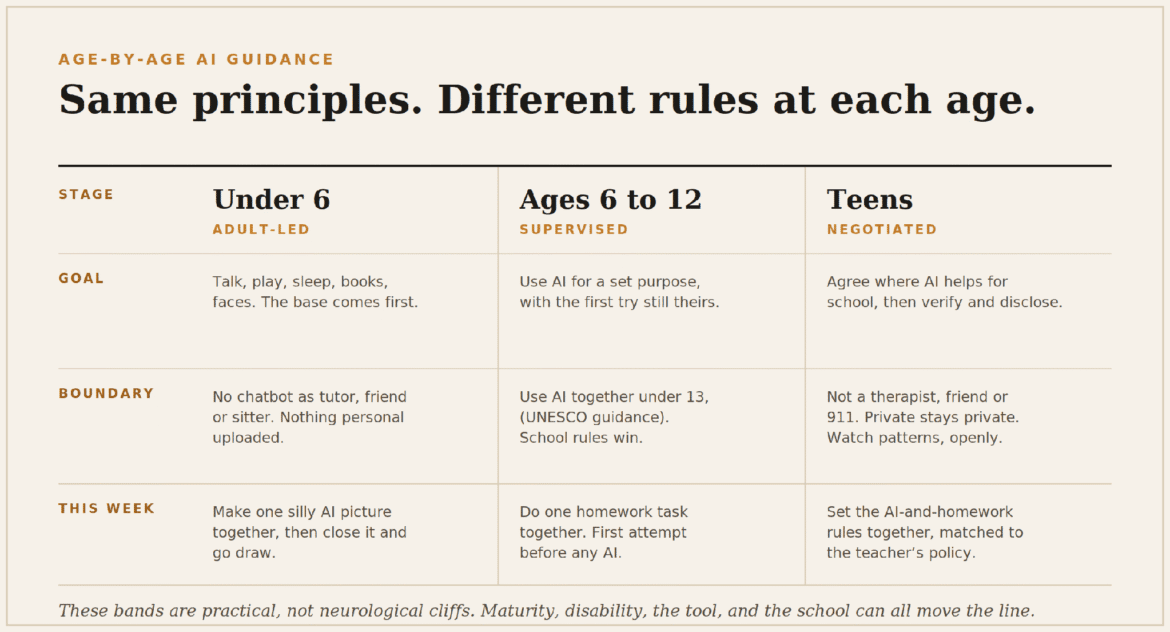
None of this lands the same way at four, at nine, and at fifteen. So here is the age-banded version, with one disclaimer up front: these bands are practical, not neurological cliffs. Maturity, disability, your child’s specific tool, and the school’s rules can all move the line.
The short version by age:
- Under six: keep AI adult-led and occasional.
- Ages six to twelve: use it together, for a clear purpose.
- Teenagers: negotiate independence without compromising privacy or safety.
Under Six: Keep AI Adult-Led
Under six, the base matters more than the technology. WHO and UNICEF keep pointing at the same unglamorous foundations: responsive talk, physical play, sleep, shared reading, and face-to-face time. Those findings are older than generative AI and have not been repealed by it.
If AI shows up at all, keep yourself in the driver’s seat. Make a silly picture together, laugh, then go back to drawing or the story. In our house the rule is simple: a general chatbot is not a tutor, a companion or a babysitter for a child this age, and their face, voice, and details do not go into one.
Ages Six to Twelve: Supervise the Purpose and the Process
From six to twelve, the move is supervised practice. UNESCO’s guidance recommends 13 as a minimum for independent classroom use or independent conversations with general-purpose generative AI. Good to know, and important to say accurately: this is international policy guidance for education settings, not a Canadian statute, and not a guarantee that any given 13-year-old is ready.
So under 13, use it together. Ask the school what it allows, and put the teacher’s rule ahead of convenience. Protect the first attempt when the point of the task is to build a skill, and teach your kid to check what the tool says against a source they trust, then explain it back without parroting the screen.
Teenagers: Negotiate Independence Without Negotiating Safety
Teenagers need real independence, and they will take it whether you negotiate or not, so negotiate. Agree together on where AI is fine for schoolwork, brainstorming, coding, or translation, matched to the teacher’s policy, and agree that anything important gets verified and disclosed when required.
The safety pieces stay non-negotiable: AI is not a therapist, not a best friend, not an emergency line, and private stays private. Watch for persistent patterns that displace sleep, school, hobbies, or human relationships, and pay particular attention when chatbot use becomes secretive or hard to stop, the kind of boundary the APA supports around dependency, companionship, and crisis use. Keep any monitoring proportionate and out in the open. My practical take: covert surveillance tends to teach secrecy faster than safety.
A Family AI Agreement You Can Start Tonight
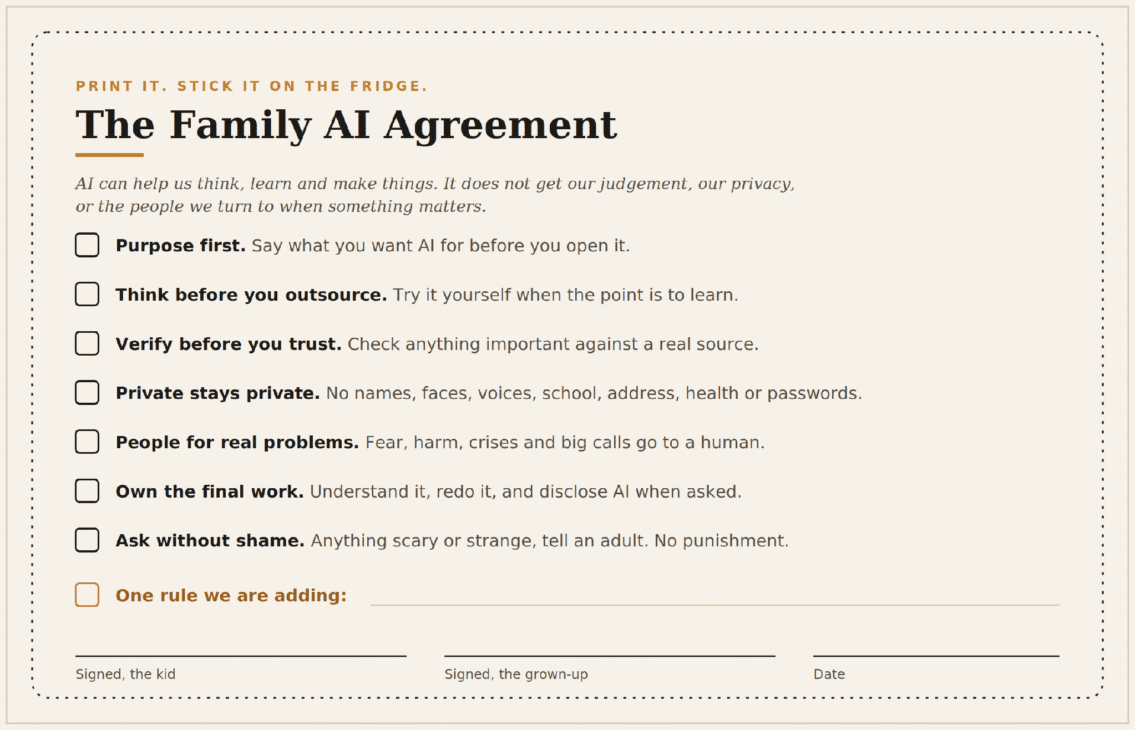
All of this stays useless if it lives in your head as a vague intention. So we wrote ours down, at the kitchen table, in about fifteen minutes. Keep it collaborative and a little imperfect. A rule your child helped write is more likely to feel understandable, workable, and shared.
Seven Rules for Safer, Smarter AI Use
- Purpose first. Say what you want AI to help with before you open it.
- Think before you outsource. Make a first attempt when the task is meant to build your own skill.
- Verify before you trust. Check anything important against a reliable source.
- Private stays private. No names, faces, voices, school details, addresses, health information, passwords, or other people’s messages.
- People for real problems. Fear, abuse, self-harm, health crises and big decisions go to a trusted human.
- Own the final work. Understand it, revise it, and disclose AI help when the rules ask you to.
- Ask without shame. If a response feels sexual, threatening, manipulative, or just strange, stop and tell an adult. Nobody gets punished for asking.
These pull together guidance from UNICEF, UNESCO, the OECD, the APA and Canadian privacy regulators into something a family can remember. They are practical rules, not laws.
Five Actions for This Week
- Ask your child which AI tools they already use, and what for. Listen all the way through before you correct anything.
- Do one homework task together using think, use, check, rebuild.
- Review privacy settings together, and delete stored chats or uploads that hold sensitive information wherever the tool lets you.
- Protect one device-free ritual: a meal, a walk, a game, or reading together.
- Tell your kid about one mistake you made, what you changed, and what you still have not figured out.
AI Guidance for Canadian Parents
| I found no single federal Canadian statute setting a minimum age for general-purpose AI-chatbot use. Check the platform’s terms, the school’s rules, privacy protections, and your child’s maturity. UNESCO recommends 13 as a policy minimum for independent classroom use and conversations with generative-AI platforms, not as Canadian law. |
The Goal Is Not an AI-Proof Child
Back to my son and the robot. Months later, I still cannot promise him anything about the tools or the jobs waiting for him. I do not know what he will need. Neither does anyone selling certainty about it.
What I can give him is smaller and, I think, bigger. A relationship where he can think out loud, be wrong without it becoming a catastrophe, ask for help without bracing for a lecture, and learn to use powerful tools without being quietly used by them. Public-health research on involved fathers is encouraging here without letting me off the hook: steady, involved dads matter for kids’ learning and emotional health. Mostly, that just means we keep showing up.
So that is the whole target now. A kid who knows exactly where to carry the hard stuff, and a dad steady enough to be standing there when he does. The AI-proofing was never really the point, and it was never possible anyway.
If you want somewhere to start tonight, write your family agreement, or read The Boy Who Became an App with your kid and let the conversation start itself. If you just need to feel less alone in the panic, that is what the Panic Club is for. And if the panic is the older, 3 a.m. kind, I wrote about the first nights of dad anxiety as well.
About the Author
Vitor Medrado is a Toronto-based writer and creative leader with more than twenty years in advertising, including senior creative roles at Ogilvy, DDB, and Publicis and recognition at Cannes Lions, the Effies, and D&AD. Today he works in creative strategy and AI integration, and he writes Dad in Panic from lived experience as a father, not as a clinician or parenting expert. Read his full bio on the Dad in Panic About page.
Selected work and press: Ads spot · Ads of the World · LatinSpots · Ads of The World · Adobo Magazine · Adlatina · AdsSpot · Publicis Brasil · Update or Die · Janela · Acontecendo Aqui · VoxNews · Blog do Adonis.
How this was made: Vitor wrote, directed, edited, and fact-checked this article against the official sources listed below, with AI assistance used for research and drafting.
Fact-checked and last reviewed: 1 August 2026.
A Few Questions Dads Keep Asking Me
Is there a legal minimum age in Canada for kids to use AI chatbots?
I found no single federal Canadian statute that sets a minimum age for using general-purpose AI chatbots. UNESCO recommends 13 as a minimum for independent classroom use or independent conversations with general-purpose generative AI, but that is international policy, not statute. Bill C-34 proposes duties for regulated AI-chatbot and social-media services, including child-safety measures. As of 1 August 2026 it was at second reading in the House of Commons, so it was not yet law. In practice you are working from each platform’s own age terms plus your own judgement, not a Canadian legal age.
What should I ask my child’s school about the AI tools it uses?
Ask three concrete things: what data the tool collects about my child, whether that data is minimized and deleted, and whether there is a privacy assessment and clear disclosure to parents. Canadian privacy regulators have asked schools to hold educational technology to exactly those standards. These are reasonable questions to submit in writing.
Is letting my child use AI for homework the same as letting them cheat?
It depends entirely on the assignment’s rules and on whether the work is disclosed. If the teacher permits AI, your child discloses the help, and they can still do the task alone, it is a tool. If the point of the task was to practise a skill your child then skipped, the grade tells a better story than the learning does, whatever the school calls it. Get the teacher’s policy in writing and treat disclosure as the default setting, not the exception.
What if my co-parent and I disagree about AI rules?
Pick the two rules you both already agree on, usually privacy and people for real problems, and start there tonight. Children can cope with adults who differ on the details, provided the basic safety rules stay consistent. Neither of you should undo the other in front of them. You can negotiate the rest when something concrete comes up, which it will, probably this week.
How can I tell whether AI helped with homework or completed it?
Ask your child to explain the answer in their own words, then give them a similar task with no AI. If they can rebuild the thinking on their own, AI probably supported the learning rather than replacing it.
Should parents read their teenager’s AI conversations?
Keep any monitoring proportionate and out in the open. Agree in advance on what you may review and why. A clear safety concern can call for stepping in, but routine secret monitoring can damage trust, so favour openness whenever you can.
What should a child do after a disturbing AI response?
Stop the conversation, keep enough on the screen to show an adult, and tell someone they trust. Nobody gets punished for reporting something sexual, threatening, manipulative, or frightening.
References
UNICEF Innocenti. Guidance on AI and Children, Version 3.0. UNICEF, 2025.
Miao F. and Holmes W. Guidance for Generative AI in Education and Research. UNESCO, 2023.
Miao F., Shiohira K. and Lao N. AI Competency Framework for Students. UNESCO, 2024.
World Economic Forum. The Future of Jobs Report 2025. World Economic Forum, 2025.
Public Health Agency of Canada. Screen Time. Nobody’s Perfect parenting resource. PHAC, 2019.
World Health Organization. Improving Early Childhood Development: WHO Guideline. WHO, 2020.