Why Does My Kid Say No to Everything? (And Is It Me?)
Short answer, before the story: usually, yes. Frequent no is common in toddlers, and it often reflects his growing independence. The part that might be you is small and fixable, and it has nothing to do with guilt.
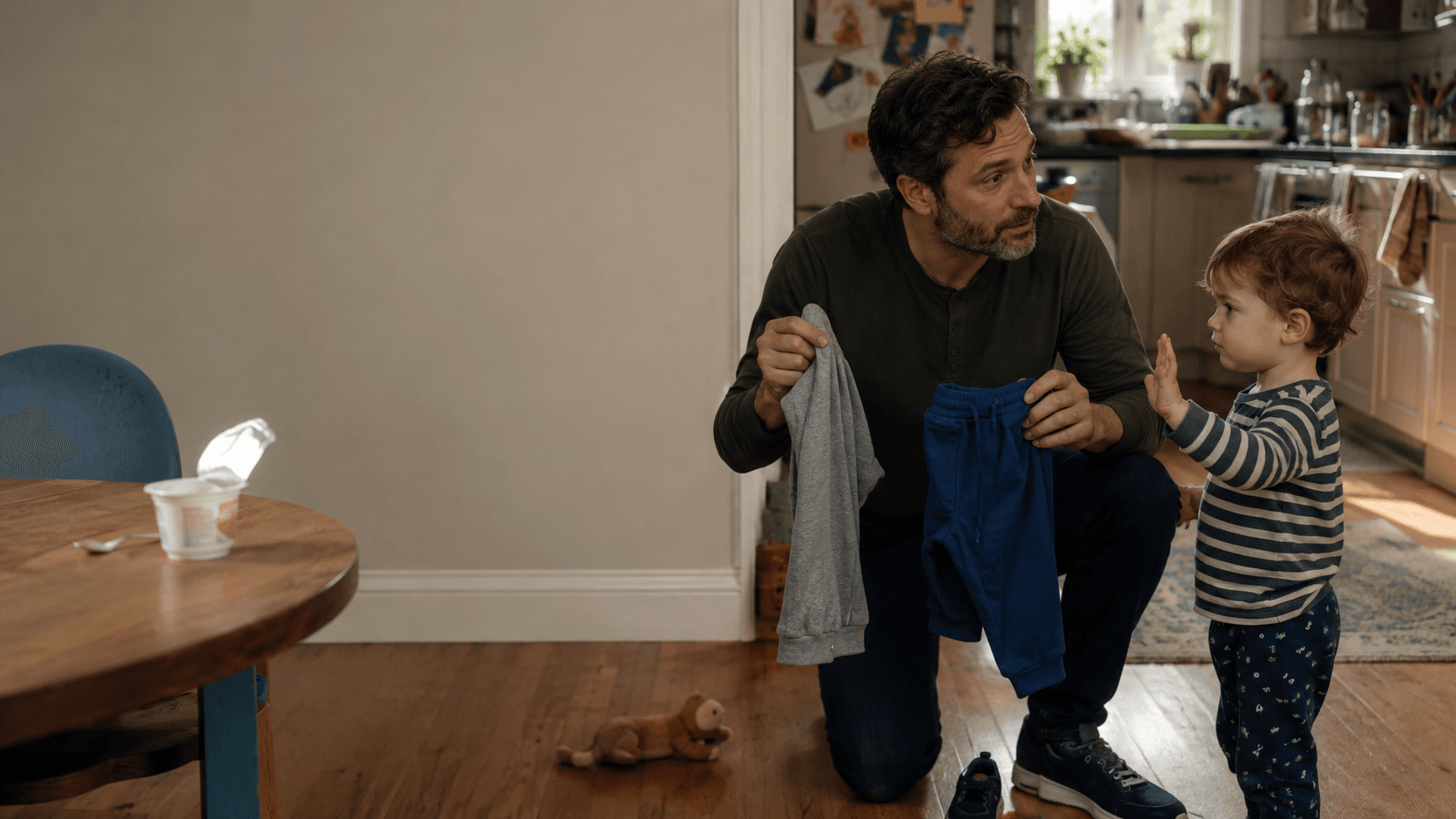
Now the story. Last Tuesday, Samuel asked me to open his yogurt. I opened his yogurt. He looked at the yogurt, looked at me, and produced a sound I can only describe as a kettle with feelings. He had wanted to open the yogurt. Himself. And a peeled yogurt lid, as any parent or physicist will confirm, does not go back on.
So I offered him a different yogurt, sealed, ready for him to open. No. I offered to hold the tub while he pulled the lid. No. I offered the spoon. No. I offered, mostly to myself at this point, to move to a small cabin very far away. No, apparently, to that too.
He said no to the yogurt, no to the spoon, no to help, and eventually no to lunch entirely, which had been his idea in the first place. I stood in my kitchen holding an open yogurt like a man who had lost a negotiation he did not know he had entered.
There is a thought that lands right about then, and it lands hard. Is something wrong with him, or is it me? Am I raising a tiny anarchist, or did I break something?
One thing before we start. This article focuses on the toddler and preschool years, roughly ages one to five, and frequent no is especially common during the toddler stretch. Age and the overall pattern still matter, so I will get to when a no is worth a call to the doctor.
I stayed up that night reading, because that is the only time I get to read anything. Here is what I found, and what I changed.
H2: Key Takeaways
- A toddler who says no to everything is usually doing something normal, not sending you a signal that you are failing as a parent.
- The no is your child’s independence drive going public. He has worked out that he is a separate person, and no is his proof.
- Frequent no is common in the toddler years. The Public Health Agency of Canada notes that children around 1½ to 2½ often like to say no a lot (Government of Canada).
- A lot of the no you get is a no you offered. Yes-or-no questions hand a toddler who is practising refusal an easy target (CDC).
- The move that helped most in my house: stop asking, and offer two real choices you can both live with, like grey pants or blue pants.
- See a doctor if tantrums worsen or stay frequent after five. Also call if they involve injury, property damage, or fainting, or come alongside regression, anxiety, nightmares, headaches, stomachaches, eating refusal, sleep refusal, or clinginess (MedlinePlus).
H2: Is It Normal for My Kid to Say No to Everything?
Usually, yes. A toddler who says no to everything is mostly running his own development, not repeating a mistake you made.
Somewhere around the first birthday, and then with real force in the toddler years, a child works out a genuinely enormous idea: I am a separate person from my parents, and I can want things they do not. The U.S. National Library of Medicine puts it plainly on its MedlinePlus page on temper tantrums. It is normal for young children to want to be independent as they realize they are separate people, and that push for control tends to arrive as saying no, a lot.
No is perfect for the job. It is short, and it works on adults instantly. Give a toddler a word that makes a grown man put down a yogurt and reconsider his life choices, and he is going to use it. Constantly. On everything. Including things he wanted eleven seconds ago.
The American Academy of Pediatrics files this under normal, not naughty. In its paediatric guidance, negativism and defiance are described as part of the ordinary march toward independence and self-reliance, the friction that happens when a small person who wants to run his own life keeps colliding with a world, and a dad, that has other plans (AAP).
The CDC’s positive-parenting guidance for this age even tells you to lean into the drive rather than crush it, to encourage his independence by letting him help dress and feed himself (CDC). The same engine behind the no is the one that is going to make him a capable person. That is genuinely useful to remember while he is refusing socks.
So the no is a kid trying on the most powerful word he owns, over and over, to find out if it is real. It is. That is the whole problem.
If you want the brain-wiring side of this, the part where a toddler literally cannot hit the brakes yet, that is what I dug into in Acting Out: When “No” Means War and You’re the Enemy. This post is about a different piece: why the no shows up in the first place, and the one thing that helped when it did.
H2: Wait, Is It Me? Why You’re Getting So Many Nos
Some of it is you. Not in the way that keeps you up at night, but in a way you can fix by Thursday. A lot of the no you are getting is a no you handed over, by asking a question when you meant to give an instruction.
Here is the pattern I caught myself in. “Do you want to put your shoes on?” “Should we brush teeth?” “Ready for the bath?” Every one of those sounds polite. Every one of those is also a yes-or-no question, which means it arrives with a no already attached, gift-wrapped, for a child whose favourite hobby this month is saying no.
The CDC makes this point without any drama in its Essentials for Parenting guidance on giving directions: if you phrase something as a question about whether your child wants to do it, you have handed him the option to refuse. You asked. He answered. You just did not like the answer.
The Public Health Agency of Canada gives the same advice in plainer words. At about 1½ to 2½, it says, a child probably likes to say no a lot, so skip the question that invites it. Do not ask “do you want to go now,” just say “we are going now,” and then offer a choice between two things you can accept (Government of Canada).
The CDC adds two more things worth sticking on the fridge. Tell your child what to do, not only what to stop doing, because “stop that” does not tell a small brain where to go instead. And remember that not being able to do something is not the same as refusing to do it, so some of the no you hear is really “I cannot yet,” wearing a no costume.
None of this makes you a bad dad. It makes you a person who was raised to be polite and is now learning that “would you like to” is a trap. I was that person. I said “would you like to” to a two-year-old roughly four hundred times before I noticed I was running a nightly referendum on bedtime, and losing it.
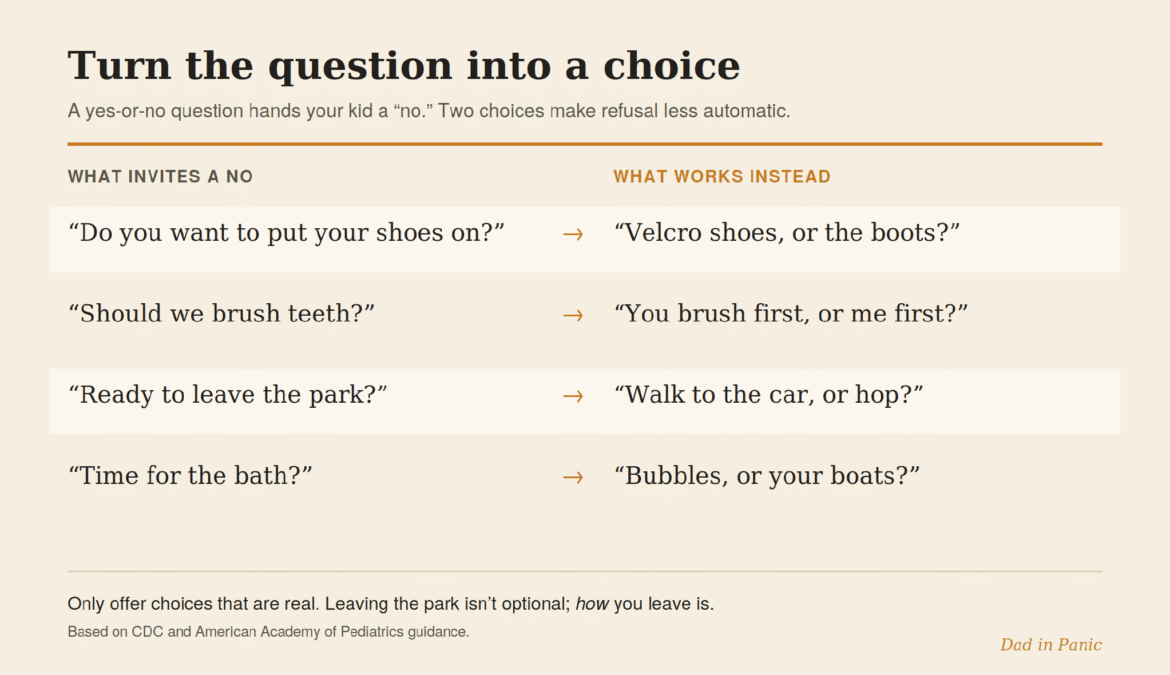
Say this instead, in plain text:
- Instead of “Do you want to put your shoes on?” try “Velcro shoes, or the boots?”
- Instead of “Should we brush teeth?” try “You brush first, or me first?”
- Instead of “Ready to leave the park?” try “Walk to the car, or hop?”
- Instead of “Time for the bath?” try “Bubbles, or your boats?”
H2: How Long Does the “No” Phase Last?
It is a stage with an exit. The loud no of the toddler years eases as your child gets better with words.
The Public Health Agency of Canada specifically notes that frequent no is common around ages 1½ to 2½, when a lot of children simply like the word (Government of Canada).
Tantrums are a related but separate thing, and they run on their own clock. MedlinePlus says they usually start between twelve months and age three, happen less often between three and five, and are rare after five (MedlinePlus), and the AAP puts the loudest stretch between ages one and three (AAP). The word and the meltdown often travel together, but they are not the same behaviour. Every kid runs his own timetable, so treat these as a weather forecast, not a train schedule.
Fatigue, hunger, and illness can make tantrums worse. In my house, they also seemed to produce more nos, so the same request that got a shrug at ten in the morning got a full no at five in the afternoon. Half the nos here were really just “I skipped my nap,” translated.
| Behaviour | Age range | What the source says |
|---|---|---|
| Frequent saying no | About 1½ to 2½ | Children commonly like to say no a lot (Public Health Agency of Canada). |
| Tantrums | Ages 1 to 3 | Usually the most active stretch (MedlinePlus, AAP). |
| Tantrums | Ages 3 to 5 | Continue, but happen less often (MedlinePlus). |
| Tantrums | After age 5 | Less common; frequent or worsening episodes are worth medical advice (MedlinePlus). |
Frequent no and tantrums overlap, but they are separate behaviours on separate timelines. Every child varies.
H2: The One Move That Helped Most in My House: Stop Asking, Offer Two

Give him a real choice between two things you are happy with, instead of a question he can refuse. It sounds almost too small to matter. It was the single change that did the most in my house.
The move is this. Take the thing that has to happen, and instead of asking whether he wants to do it, hand him a choice inside it. Not “do you want to get dressed,” which invites the no. “Grey pants or blue pants,” which spends the same urge, his drive to decide for himself, on a choice that ends with a dressed kid either way.
The CDC recommends offering two simple choices to encourage a child’s independence, and adds that two is usually plenty, since a wall of options just overwhelms him (CDC). The AAP says the same thing for the middle of a meltdown: give your child control over small things, offer directed choices rather than yes-or-no questions, and choose your battles (AAP). It only looks like a trick. Really you are handing over the control he was fighting for, in a size that fits your kitchen.
Two honest cautions, because this can backfire if you get them wrong.
First, the choice has to be real. MedlinePlus is blunt about this: do not offer a choice that does not actually exist (MedlinePlus). “Do you want to walk or hop to the car” is fine, because either way you are leaving the park. But if staying is not an option, do not offer it. Both choices must be real.
Second, keep the non-negotiables off the menu entirely. The car seat, the hot stove, anything where the real answer is safety, none of that is a two-option game. MedlinePlus draws the same line: do not fight over trivial things like which shoes he wears, and hold firm on the things that are actually about safety (MedlinePlus). Choices are for the stuff that does not matter, so you have all of your authority left for the stuff that does.
That is the whole move. Mostly it is fewer questions and more “this one or that one,” with a short list of things that were never up for debate. It will not end the nos. Samuel still says no. But it turns most of the daily standoffs from a fight over whether into a quick pick between two, and that swap gave me back roughly an hour a day and most of my patience.
H2: When Is It More Than a Phase?
Most of the time, a toddler who says no is just being the age he is. A few patterns, though, are worth a conversation with your doctor rather than waiting out.
MedlinePlus, drawing on AAP guidance, lists several signs worth raising with your child’s provider. These include tantrums that get worse or keep happening often after age five. Call if your child hurts himself or other people, wrecks things, or holds his breath and faints during a tantrum. Other signs include nightmares, sliding backward on toilet training, headaches or stomachaches, anxiety, refusal to eat or sleep, or new clinginess (MedlinePlus). It also says something I wish more guidance did: get help for you, too, if you cannot keep a lid on your own anger, or you are scared of how you might react.
A bad day is not a diagnosis. The point is just to know the short list, so that if something on it shows up and stays, you make the call instead of quietly worrying about it late at night. If any behaviour worries you, ask your doctor rather than trying to diagnose it yourself.
For the deeper version of this, the difference between ordinary defiance and patterns that need more support, I went further in Acting Out: When “No” Means War and You’re the Enemy. If the no in your house feels less like a phase and more like a pattern, start there.
| Common toddler patterns | Worth a conversation with your doctor |
|---|---|
| Says no to transitions, offers of help, and things he wanted a minute ago | Tantrums that keep getting worse, or stay frequent past age five |
| Big feelings that pass with comfort, food, or a nap | Hurting himself or others, or destroying things, during tantrums |
| The occasional dramatic meltdown that ends and is forgotten | Breath-holding during tantrums, especially with fainting |
| Refusal that eases as his words improve | Tantrums alongside nightmares, toilet-training regression, headaches, stomachaches, anxiety, food or bedtime refusal, or clinginess |
Signs on the right paraphrased from MedlinePlus, “Temper tantrums” (citing the American Academy of Pediatrics). This is a guide, not a diagnosis; your doctor is the right call for anything that worries you.
H2: About the Author
Vitor Medrado is a Toronto-based writer and creative leader with more than twenty years in advertising, including senior creative roles at Ogilvy, DDB, and Publicis, and recognition at Cannes Lions, the Effies, and D&AD. Today he works in creative strategy and AI integration, and he writes Dad in Panic from lived experience as a father, not as a clinician or parenting expert. Read his full bio on the Dad in Panic About page.
How this was made: Vitor wrote and fact-checked this article against the official sources listed below, with AI assistance used for research and drafting.
Last reviewed: September 2026.
H2: References
H2: Frequently Asked Questions
My kid says no even to things he loves. What is going on?
Sometimes the no is about control rather than the activity itself. Being tired, feeling frustrated, or a hard transition can produce the same answer. Offer two acceptable choices, “now or after we wash hands,” and he may reconnect with what he wanted.
Should I stop giving choices so he stops running the show?
No. Taking choices away can crank the nos up, because then the only control he can grab is refusal. The fix is usually the opposite: more small, real choices inside your limits, so his need to decide has somewhere to go and does not have to stage a coup over shoes.
Is offering choices just negotiating with a toddler?
It feels like it, but there is a real difference. Negotiating is opening a decision you have not made yet, like “what if you wore no coat.” A two-option statement is a decision you already made, handed over in two acceptable flavours. You decided he is wearing a coat. He decides which one.
He says no and then does the thing anyway. Do I correct the no?
Usually not. If he follows the direction, focus on the cooperation and let the attitude go. The CDC recommends this approach when a child complies with a bad attitude (CDC). Turning a finished task into a lecture about attitude just starts a second fight you did not need.
My partner gets far fewer nos than I do. Am I doing something wrong?
Maybe, but probably not in the way it feels. Compare your wording, timing, routines, and responses before deciding he prefers one parent. One of you may simply use fewer yes-or-no questions.
Is it normal for a child over five to keep saying no?
Some disagreement at five and up is just a kid with opinions, which is a good thing to be raising. What is worth a closer look is toddler-style trouble that hangs around or gets worse: tantrums that are frequent or worsening, hurting himself or others, or tantrums that come with things like anxiety, regression, or trouble sleeping or eating. MedlinePlus flags those as reasons to talk to your doctor (MedlinePlus). Ordinary “no, I do not want to” is not on that list. Age and the overall pattern are what matter.